
Golf Bankroll Management Tips: Sizing Units and Protecting Your Betting Fund
 Available in US

August 2021 nearly ended my golf betting career. I’d been running well — two months of profit, an outright place at 33/1 that inflated my confidence, and a bankroll that looked healthier than at any point since I started. So I did the worst thing possible: I increased my unit size for the FedEx Cup Playoffs. Three weeks later, after a catastrophic sequence of losses at elevated stakes, I’d wiped out four months of profit. The bankroll wasn’t just back to where it started — it was below it. The selections hadn’t been terrible. The staking had been disastrous.
The problem gambling rate among UK adults sits at 2.7% as measured by the PGSI, and among online sports bettors specifically it jumps to 7.2%. I’m not equating poor bankroll management with problem gambling — they’re distinct issues — but the emotional pattern that leads to staking mistakes is the same pattern that, unchecked, escalates into genuinely harmful behaviour. Building a bankroll management system isn’t just about protecting your money. It’s about protecting your process from the version of yourself that makes bad decisions under pressure.
Setting Up a Unit-Based Bankroll
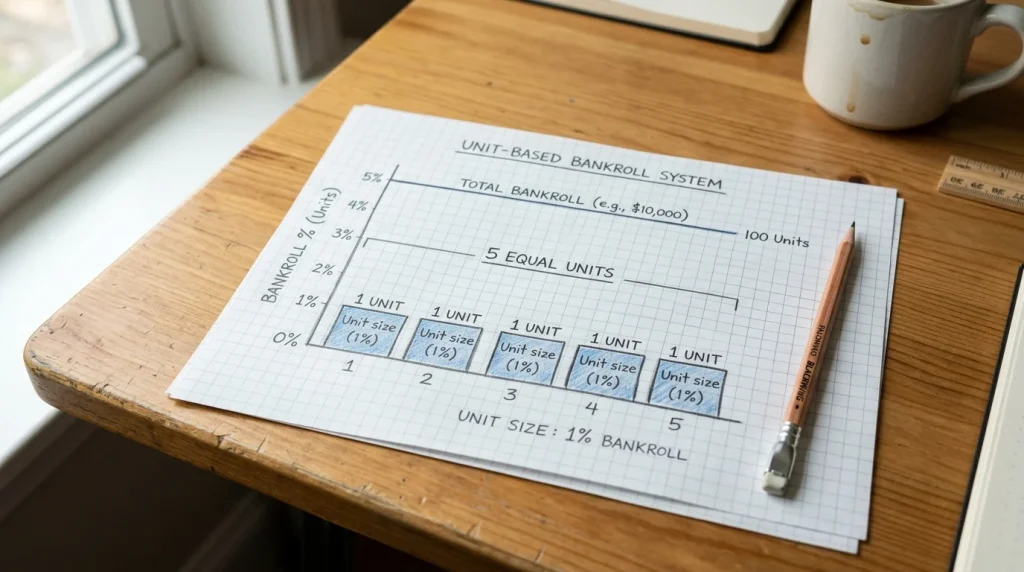
A unit system is the foundation. Your bankroll is the total amount you’ve dedicated to golf betting — money you can afford to lose entirely without affecting your daily life. Your unit is a fixed percentage of that bankroll, and every bet is expressed in units rather than pounds. This sounds basic, but it imposes the discipline that emotional bettors lack: the unit size stays constant regardless of recent results, which means a winning streak doesn’t inflate your exposure and a losing streak doesn’t encourage desperate chasing.
I use a 1% unit size. On a £2,000 bankroll, one unit is £20. My standard bet on a value selection is 1 unit. For selections with stronger edge — where my model suggests a probability 30% or more above the bookmaker’s implied probability — I’ll go to 1.5 units. Never above 2 units under any circumstances. At 40-50 bets per week across multiple markets, my total weekly exposure typically runs between 6-10% of bankroll. That ceiling matters: even a week where every bet loses — which happens more often than you’d like to believe — costs me less than 10% of my fund.
The unit size doesn’t change mid-season unless the bankroll itself has changed by more than 25% in either direction. If the bankroll grows from £2,000 to £2,500, I recalculate: 1% of £2,500 = £25 per unit. If it drops to £1,500, the unit shrinks to £15. This proportional adjustment ensures I’m betting less when the fund is under stress and more when it’s healthy — the opposite of what emotional bettors do instinctively.
Allocating Across Markets and Tournaments
A common mistake I see in golf betting discussions is treating the bankroll as a single pot and allocating randomly based on weekly conviction. My approach is to divide the bankroll into market-specific allocations that reflect each market’s risk profile and expected return pattern.
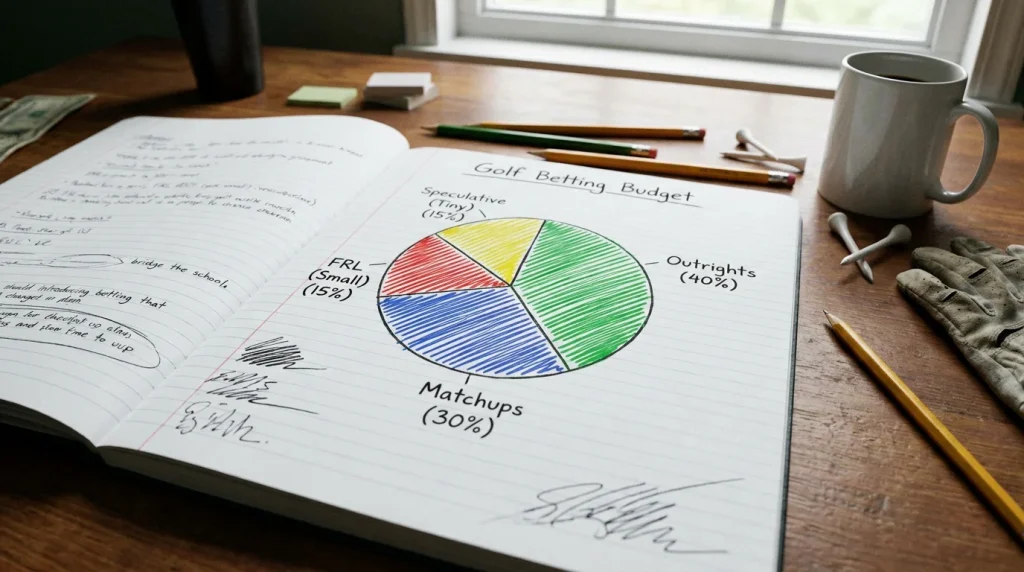
I allocate roughly 40% of my weekly budget to each-way outright and top-finish bets, 30% to head-to-head matchups, 15% to first round leader and cut-line bets, and 15% to speculative plays (accumulators, in-play, props). The weighting reflects where my edge is strongest: matchups have been my highest-ROI market over the last three seasons, but each-way outrights generate the largest absolute profit because the individual payouts are higher.
Tournament-level allocation matters too. I bet more heavily on events where I have strong course-fit data and where the field composition aligns with my analytical strengths. At a signature PGA Tour event with a 70-player field and deep ShotLink data, I might deploy 8-10% of weekly bankroll. At a weaker DP World Tour event where data is patchy, I scale back to 4-5%. The adjustments aren’t random — they follow a pre-season plan that maps each week of the calendar to an allocation band based on field strength and data availability.
Stop-Loss Rules and Drawdown Limits
If I hit a 15% drawdown in any calendar month, I reduce my unit size by 25% for the following two weeks. If the drawdown reaches 25%, I stop betting entirely for one full tournament week and spend that time reviewing my model, not my results. These aren’t arbitrary numbers — they’re based on my historical variance. Over five seasons of tracking, my longest losing run was 23 consecutive outright bets without a return, which corresponded to a 19% drawdown. The 15% trigger catches that run before it spirals.

Stop-loss rules feel unnecessary when things are going well, which is exactly when you should set them. Write your rules down in the same document as your staking plan, and follow them mechanically. The moment you start negotiating with your own rules — “I’ll skip the pause this time because the field next week is perfect” — you’ve already lost the discipline that the rules exist to protect.
One refinement I’ve added in the last two years: separate drawdown tracking by market type. If my matchup bets are profitable but my outright bets are bleeding, the drawdown on outrights triggers a pause on outrights specifically, not a blanket shutdown. This lets me continue profiting in the market where I have edge while protecting capital in the market where my process might be misfiring.
Recording Every Bet: Spreadsheet Essentials
I track every bet in a dedicated spreadsheet with the following fields: date, tournament, player, market type (outright, top-10, matchup, FRL, etc.), odds, stake in units, bookmaker, outcome, return, and a brief note on why I placed the bet. That last column — the “why” — is the most valuable field in the entire sheet. When I review losing months, the notes tell me whether the losses came from poor analysis, poor staking, or pure variance. Without that context, a loss is just a number, and numbers alone don’t fix process errors.
The spreadsheet also calculates running ROI by market type, by tour, by month, and by odds band (under 10/1, 10/1-25/1, 25/1-50/1, over 50/1). These breakdowns reveal patterns that aggregate ROI hides. My first full year of tracking showed me that my ROI on players priced between 25/1 and 50/1 was +14%, while my ROI on players above 50/1 was -28%. I was losing money on the longest shots and making it back on the mid-range prices. Without the granular data, I’d never have spotted that and adjusted. For a deeper dive into tracking methodology and ROI analysis, my guide to building a golf betting strategy covers the review cycle in detail.

Golf Bankroll Management: Common Questions
How do I build a golf betting bankroll management system?
Start by defining your total bankroll — money dedicated exclusively to golf betting that you can afford to lose. Set a unit size at 1-2% of that bankroll. Every bet is expressed in units, and the unit size stays constant unless the bankroll changes by 25% or more. Divide your weekly allocation across market types based on historical edge, and set stop-loss rules that trigger reduced activity or a pause at predetermined drawdown levels.
What percentage of my bankroll should each golf bet use?
A standard single bet should use 1% of your bankroll (one unit). Stronger-edge selections can go to 1.5 units. Never exceed 2 units on a single bet. Total weekly exposure across all bets should stay below 10% of your bankroll. These limits ensure that even a complete weekly wipeout — every bet losing — doesn"t threaten the long-term viability of your fund.
Articles
Created by the "Golf Betting Tips" editorial team.
