
Golf Field Strength Analysis: Quantifying Tournament Quality Before You Bet
 Available in US

The week that changed how I think about field strength was a mid-season PGA Tour event in 2022. A player I’d been tracking — solid approach numbers, strong recent form, good course history — was priced at 45/1. He’d have been 25/1 in a signature event, but the top thirty players in the world were resting that week. I backed him. He finished third. The each-way return was three times what the same selection would have paid in a full-strength field, and the edge had nothing to do with the player. It had everything to do with who wasn’t there.
Field strength is the single most overlooked variable in recreational golf betting. Most punters assess a player’s chance of winning without first assessing the field they need to beat. That’s like evaluating a sprinter’s 100-metre time without checking who else is in the race.
Why Field Strength Changes Every Market on the Card
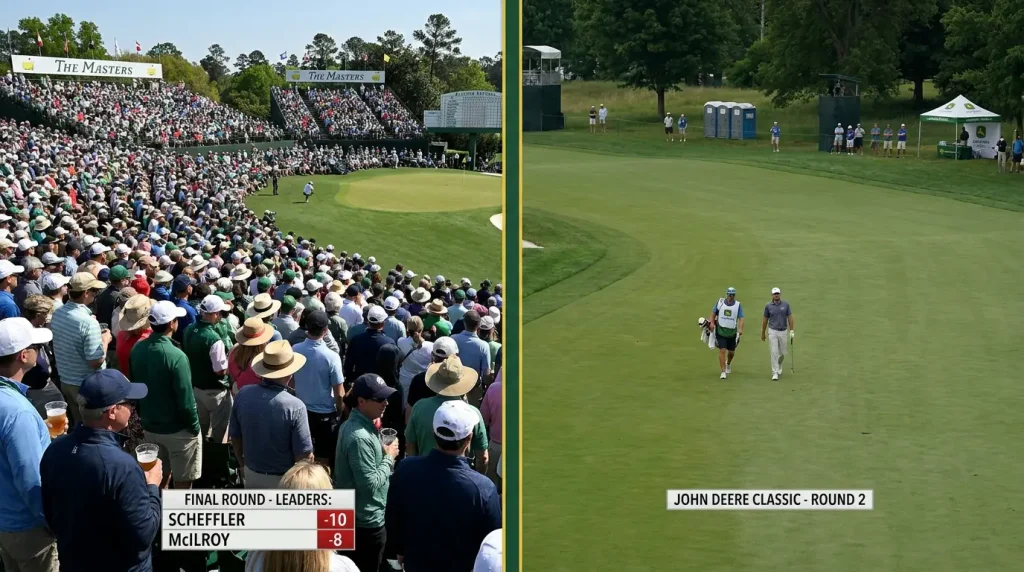
Data from one major US sportsbook showed that 99.4% of its golf betting handle lands on PGA Tour events, but the quality gap between the strongest and weakest PGA Tour fields in any given season is enormous. A signature event featuring the top 70 players in the world is a fundamentally different betting proposition from an opposite-field event where half the entrants are outside the top 200. The outright odds, the each-way terms, the matchup pricing, the top-finish markets — every number on the card is built on an implicit assumption about field quality.
When the field is strong, the distribution of talent is compressed. The difference in ability between the 10th-ranked player and the 50th-ranked player is small enough that form, course fit and luck play outsized roles in determining the outcome. Outright odds are tightly bunched, favourites are shorter, and value is harder to find because the market has more data points to price from. When the field is weak, that compression disappears. The gap between the best player in the field and the 50th best is wide enough to be predictive on its own, and the market often underestimates how much that gap matters.
I adjust my entire analytical approach based on field strength before looking at a single player. In a strong field, I focus on marginal edges — course-fit details, putting surface preferences, weather interactions. In a weak field, I focus on talent identification: which of the 10-15 genuinely strong players in the field is most likely to translate their ability into a result against weaker opposition? The analytical question is different, and treating all fields identically is a process error that costs bettors money every week of the season.
Measuring Field Strength: OWGR Points and Custom Ratings
The Official World Golf Ranking provides the most accessible starting point for field strength assessment. Every player in the field carries an OWGR points average, and summing those averages — or averaging the top 30 entrants — produces a single number that represents the aggregate quality of the field. The PGA Tour recorded a 20% increase in golf betting handle in 2025, partly driven by the introduction of signature events with elevated fields that concentrate top-ranked players into fewer tournaments.
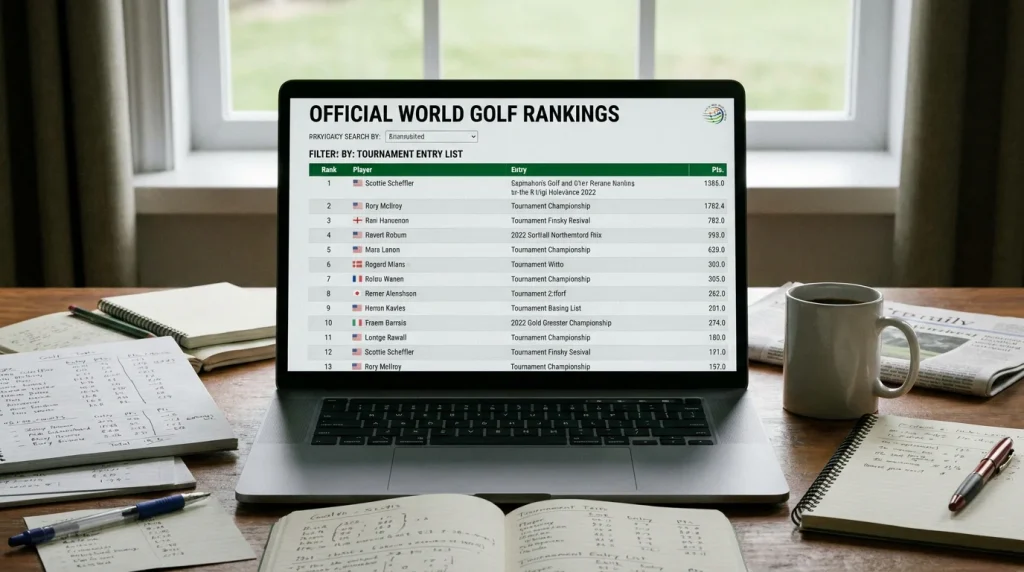
I use OWGR as a baseline but not a final answer. The ranking system has well-documented biases: it rewards consistent play over peak performance, it struggles with players who split their schedule between tours, and its time-weighting system means a player who peaked eighteen months ago may still carry a ranking that overstates their current ability. For betting purposes, I supplement OWGR with a custom rating built from the last 24 rounds of strokes gained data, weighted toward more recent performances.
The practical implementation is a three-tier classification. Tier 1 fields feature an average top-30 OWGR points above a threshold I’ve calibrated to the signature event standard — typically the top 10-15 events on the PGA Tour calendar. Tier 2 fields sit in the middle range: strong enough to feature several genuine contenders but shallow enough that the drop-off from 20th to 80th in the field is significant. Tier 3 fields are opposite-field events and weaker DP World Tour tournaments where the talent concentration is thin.
Each tier triggers a different staking and market strategy. Tier 1 events get my full analytical process but reduced staking on outrights because the market pricing is most efficient when the field is strongest. Tier 2 events are my bread and butter — enough data to model accurately, enough field weakness to find mispriced selections. Tier 3 events get smaller stakes but more speculative selections, targeting each-way value on players whose talent level is well above the field average.

Weak-Field Events: Where Long Shots Turn into Realistic Picks
My tracking data across four seasons shows a consistent pattern: ROI on outright bets is highest at Tier 2 and Tier 3 events. That result contradicts the intuition that stronger fields produce more predictable outcomes and therefore easier bets. The reality is the opposite. Strong fields produce efficient markets where every participant is well-known, thoroughly analysed and accurately priced. Weak fields produce inefficient markets where the pricing engine — driven by public perception and limited analytical attention — leaves gaps.

Consider a player ranked 80th in the world entering a weak-field event where the highest-ranked entrant is 35th. On raw ability, our 80th-ranked player might be the 8th or 10th strongest golfer in the field. In a signature event, that same player would be 60th or 70th in the ability distribution. The DP World Tour schedule is particularly rich in these opportunities: non-co-sanctioned events often feature fields where a handful of strong players face limited opposition, and each-way terms remain standard regardless of field depth.
The trap with weak-field betting is assuming that the strongest player in a weak field will simply win. Golf doesn’t work that way. A 156-player event still has 156 possible winners, and the variance inherent in four rounds of stroke play means that even a dominant talent-to-field advantage converts to victory only 10-15% of the time for the best player in a weak field. What changes isn’t the win probability for any individual selection — it changes the number of players with a realistic chance. In a signature event, perhaps 30-40 players could credibly win. In a weak-field event, that number shrinks to 15-20. Betting on any one of those 15-20 at weak-field prices versus signature-event prices is where the value lives.
I build my weak-field shortlist by filtering for players whose strokes gained profile — particularly tee-to-green — sits a full standard deviation above the field average. Then I check recent form over the last 12 rounds to ensure they’re not carrying that profile in from a hot streak six months ago. The intersection of structural talent advantage and current form, priced at weak-field odds, has been the most reliable source of positive expected value in my entire betting portfolio.

Field Strength Analysis: Common Questions
How do I assess the strength of a golf tournament field?
Start with the Official World Golf Ranking: average the OWGR points of the top 30 entrants to produce a single field-quality score. Compare that score against a full season"s range to classify the event as strong (signature level), medium or weak (opposite-field). Supplement OWGR with recent strokes gained data, as the rankings can lag behind current form. Field strength should adjust your staking level, market selection and analytical intensity for each event.
Does a weaker field always mean better value for outsiders?
Not automatically. A weaker field means fewer players with a realistic chance of winning, which concentrates probability among the stronger entrants. The value appears when bookmakers don"t fully adjust outright prices downward for the top players in a weak field — they may still be priced at 20/1 when their true probability in that specific field is closer to 12/1. The edge is in the pricing gap, not the field weakness itself. You still need course-fit analysis and form validation; a weak field doesn"t turn a poorly suited player into a contender.
Articles
Published by the Golf Betting Tips team.
