
Golf Top 5 Finish Betting: Strike Rate, Pricing and When Position Markets Beat Outrights
 Available in US
My betting spreadsheet tells a story I didn’t expect when I first started tracking. Across three full seasons, my outright winner bets show a ROI of +6.2% — solid, if you can stomach the losing runs. My top-10 finish bets show +8.7%. But my top-5 finish bets? They sit at +11.4%, making them the most profitable market in my entire golf portfolio. The reason isn’t that I’m better at predicting top-5 finishes than tournament winners. The reason is that the pricing in position markets is systematically softer than in outright markets, because bookmakers dedicate more modelling resource to the headline outright lines.
The PGA Tour recorded a 20% increase in golf betting handle in 2025, and position-finish markets absorbed a disproportionate share of that growth. As more casual punters enter the market looking for better strike rates than outright betting offers, the demand for top-5, top-10 and top-20 markets has pushed bookmakers to expand their offerings. That expansion has created more opportunity — and more pricing gaps — for the punter who understands how position probabilities really work.
Top 5, Top 10 and Top 20 Markets Compared
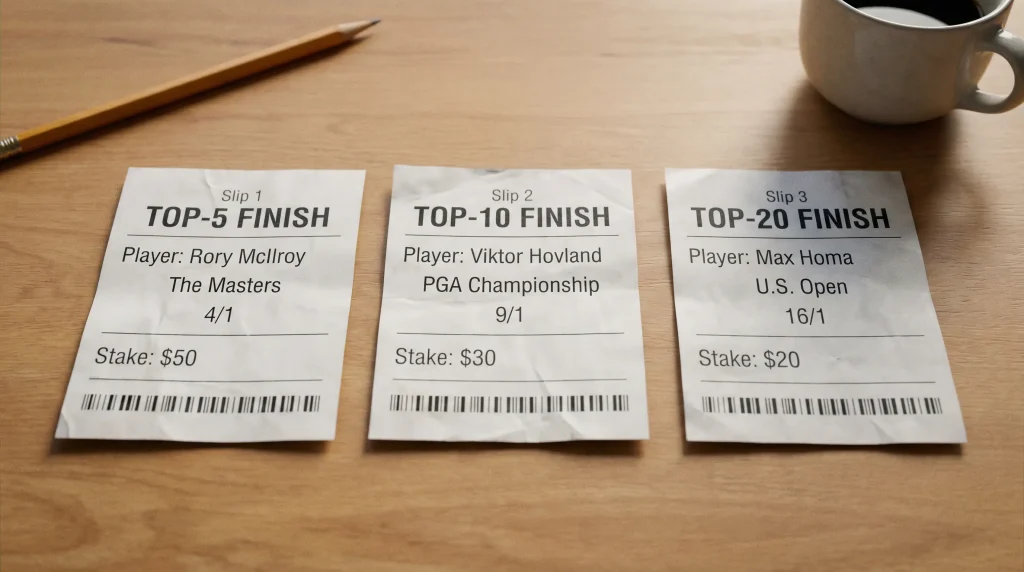
The three standard position markets form a risk-reward spectrum that every golf bettor should understand. A top-5 bet pays the best odds but hits the least often. A top-20 bet hits frequently but at compressed prices. Top-10 sits in the middle and, in my experience, offers the best balance for most bankroll structures.
Let me put numbers on this. For a mid-ranked player at a standard PGA Tour event — someone priced around 40/1 for the outright — typical position prices might look like: 6/1 for top 5, 5/2 for top 10, even money for top 20. The implied probabilities behind those prices are roughly 14% (top 5), 29% (top 10), and 50% (top 20). The strike rates from my own records, filtered for properly researched selections, run close to those percentages: 17% for top 5, 34% for top 10, 55% for top 20. The gap between my actual strike rate and the bookmaker’s implied probability is where the profit lives.
The global sports betting market is projected to reach $575 billion by 2035, and golf’s position markets represent one of the most accessible entry points for new bettors within that expanding ecosystem. The lower variance compared to outrights means a smaller bankroll can sustain a meaningful betting programme over a full season.
How to Estimate a Player’s Top-Finish Probability
This is where course-fit analysis directly translates into market-specific edge. My estimation process starts with the same strokes gained profiling I use for outright analysis, but the conversion from “this player fits the course” to “this player will finish top 5” requires an additional step: historical finishing-position distributions.
The FedEx Cup Playoffs saw betting handle rise 50% year-on-year in 2025, and those elevated-field events provide the cleanest data for calibrating position probabilities. In a 70-player signature event, a player whose SG: tee-to-green ranks in the top 15% of the field has historically finished top 5 approximately 22% of the time, top 10 approximately 38% of the time, and top 20 approximately 58% of the time. In a 156-player full-field event, the same relative ranking produces lower absolute probabilities: roughly 14%, 26%, and 42% respectively, because the larger field introduces more variance.
I maintain a lookup table that converts field rank by composite SG score into position probabilities for each field size. The table is calibrated from five seasons of PGA Tour data and I update it annually. When I profile a player against this week’s course demands and their composite score ranks them 12th in the field, I can immediately estimate their top-5, top-10 and top-20 probabilities without running a separate model. That speed matters on Wednesday and Thursday mornings when odds are moving.

Position Bets vs Outrights: Risk-Reward Trade-Off
The question I get asked most often about position betting is “why not just bet each-way outrights instead?” It’s a fair challenge, and the answer depends on your bankroll size and your psychological tolerance for losing runs.
Each-way outright bets combine win and place components, which means you’re paying for two bets on every selection. A £10 each-way at 40/1 costs £20 total. If your player finishes 8th, the win half loses entirely, and the place half (assuming 1/5 odds for 8 places) returns modestly. A £20 top-10 bet on the same player at 5/2 costs £20 and returns £70 if the player finishes anywhere from 1st to 10th. The top-10 bet has a higher strike rate for the same outlay because you’re not paying for the low-probability win component.
The trade-off: you lose the upside. If the player wins the tournament, the each-way bet returns massively on the win half. The top-10 bet returns the same £70 whether the player finishes 1st or 10th. My solution is to split my allocation: core position bets for consistent returns, supplemented by selective each-way outrights on players where my model suggests a win probability meaningfully higher than the market implies.

Picking the Right Position Threshold
Not every player suits every position market. My rule of thumb: back consistent, low-variance players in top-5 markets, and back high-variance, high-ceiling players in top-20 markets. The logic is that outright contenders with volatile scoring profiles might miss the cut one week and finish 3rd the next. Their top-5 hit rate is unpredictable, but their top-20 hit rate is more stable because the wider threshold captures both their peaks and their decent-but-not-spectacular weeks.

The pricing on these thresholds also reveals bookmaker assumptions worth challenging. The spread between top-5 and top-10 odds for the same player is usually tighter than the actual probability difference warrants. A player at 6/1 for top-5 and 2/1 for top-10 implies the bookmaker sees the gap between finishing 5th and 10th as narrow. For a consistent ball-striker on a course that suits their profile, that gap might genuinely be narrow — but for a streaky player whose results cluster at the extremes, the gap is wider than the pricing suggests, and the top-20 market often represents better value than either top-5 or top-10.
If you add the implied probabilities of every player in a golf outright market, the total exceeds 100% by 30-50%. Position markets carry smaller overrounds — typically 10-20% — because the bookmaker is pricing a binary outcome (top 5 or not) rather than distributing probability across 156 possible winners. That structural reduction in house edge is one reason I allocate 30-40% of my weekly card to position bets rather than concentrating entirely on outrights. The maths favours the market where the bookmaker takes less.
Conversely, steady players who rarely crack the top 3 but regularly finish between 5th and 15th are ideal top-5 or top-10 candidates. Their consistency is the asset, and the position market rewards consistency more effectively than the outright market, which demands the exceptional performance they rarely produce.

Top-Finish Golf Betting: Common Questions
Is top 5 betting better value than top 10 in golf?
It depends on the player profile and the pricing. Top-5 bets offer higher odds but lower strike rates, making them more suitable for consistent performers who regularly contend. Top-10 bets offer a better balance of price and probability for most selections. In my experience, top-10 markets carry the most consistent value because bookmakers price them with less precision than outright or top-5 markets.
Do top-finish bets include tied positions?
Yes, but tied positions at the boundary can trigger dead heat rules. If your top-10 bet covers a player who ties for 10th with two others, the dead heat rule divides your stake by the number of players sharing that position. Players who finish tied for any position above the boundary — such as tied for 8th in a top-10 market — are unaffected by dead heats because they are inside the covered range regardless of the tie.
Articles
Written by the editors at Golf Betting Tips.
