
How to Read Golf Betting Odds: Fractional, Decimal and Implied-Probability Conversions
 Available in US
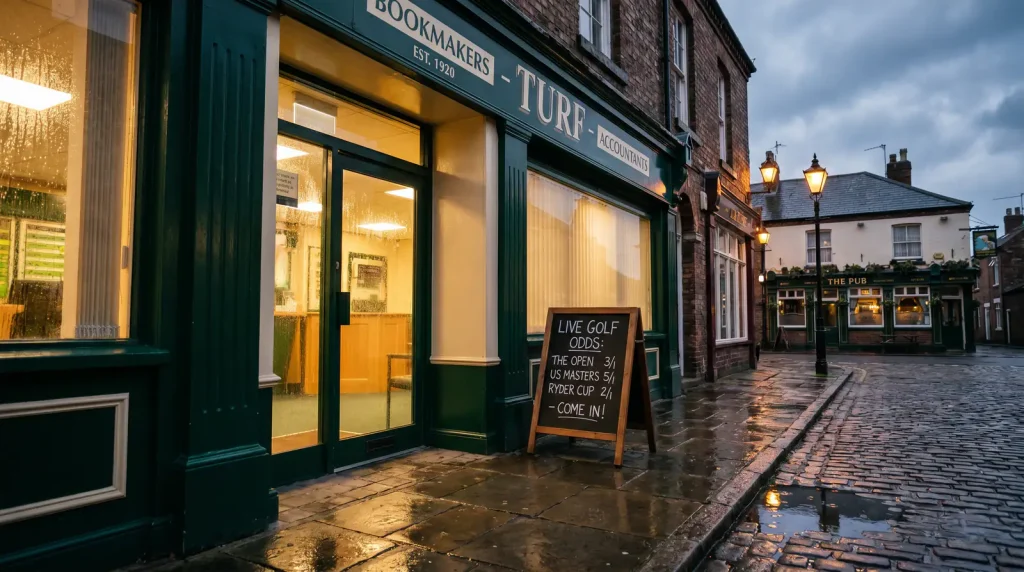
I spent my first six months of golf betting completely ignoring the numbers on the screen. I knew “40/1” meant long odds and “6/1” meant short odds, and that was the extent of my literacy. It was like reading a menu in a foreign language — I could recognise a few words, but I had no real comprehension of what I was ordering.
The UK sports betting market generates approximately GBP2.48 billion in annual gross gaming yield, making it one of the largest regulated markets on the planet. Every pound of that flows through a pricing mechanism — odds — that most punters accept at face value without understanding what the number actually represents. Odds are not just a payout multiplier. They are a probability statement. They tell you exactly what the bookmaker thinks about a player’s chances, and once you can read that statement fluently, you can start identifying where the bookmaker might be wrong.
This guide covers the two odds formats you will encounter most often in UK golf betting — fractional and decimal — and then moves into the concept that ties them together: implied probability. By the end, you will be able to convert between formats, calculate what any set of odds really says about a player’s chances, and compare prices across bookmakers to find the best available number.
Fractional Odds: The Format UK Bookmakers Use by Default
Walk into any betting shop on a British high street and the odds board will be in fractional format. It is the default language of UK bookmaking, and golf markets are no exception. Understanding how to read it — really read it, not just glance at it — is the foundation of everything else in this guide.
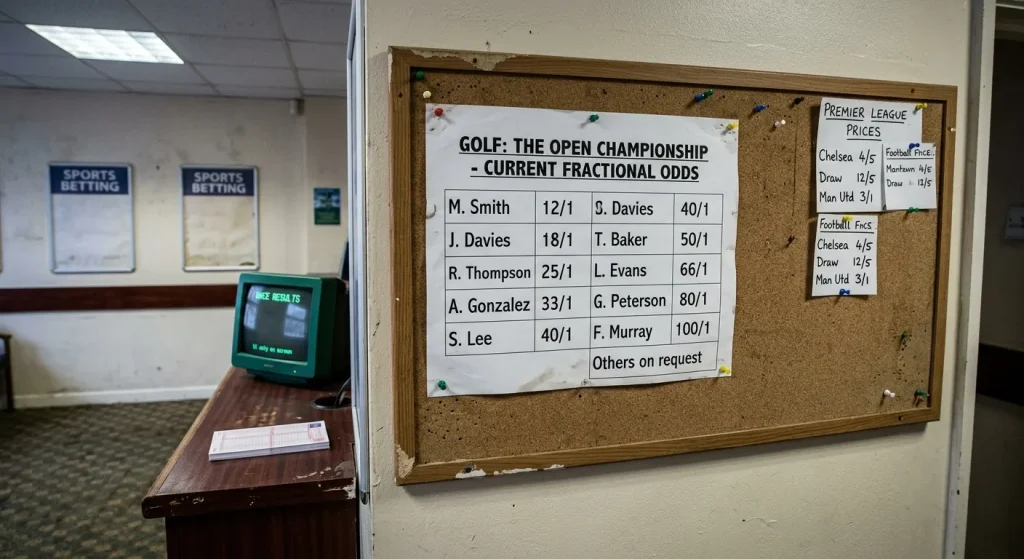
A fractional odd like 40/1 (spoken as “forty to one”) means that for every GBP1 you stake, you win GBP40 in profit if the bet lands, plus your original GBP1 stake returned. Total return on a GBP1 bet at 40/1: GBP41. On a GBP5 bet: GBP205. The numerator (40) is the profit. The denominator (1) is the stake. The ratio between them tells you the payout.
Golf odds get more interesting at non-standard fractions. A player priced at 14/1 returns GBP14 profit per GBP1 staked. A player at 9/2 returns GBP4.50 profit per GBP1. A player at 11/4 returns GBP2.75. The pattern is always the same: divide the numerator by the denominator, and you have the profit per pound.
Where beginners trip up is with odds-on prices — fractions where the denominator is larger than the numerator. In golf, odds-on is rare for outright markets (a field of 156 players means no one is a heavy favourite), but it appears regularly in matchup bets. A player priced at 4/7 in a head-to-head requires you to stake GBP7 to win GBP4 in profit. The total return on a GBP7 bet is GBP11 — your GBP7 stake plus GBP4 profit. The price is telling you this player is more likely to win than to lose, and the payout reflects that.
Fractional odds in golf typically follow a pattern by player tier. The tournament favourite might sit at 7/1 or 9/1. Serious contenders range from 14/1 to 25/1. The middle of the field runs 33/1 to 66/1. Outsiders stretch from 80/1 to 200/1, and the tail end of the market — qualifiers, past champions, and borderline entries — can reach 500/1 or longer. Each band represents a different class of probability, and the jump between them is not linear. A player at 33/1 is not twice as likely to win as a player at 66/1 in the bookmaker’s estimation — the difference is closer to 1.5 percentage points of implied probability, which at these low levels is a significant gap.
One practical note: fractional odds in golf often include unusual denominators. You will see 28/1, 33/1, 40/1, 66/1, 80/1 — numbers that do not simplify neatly. This is normal. Bookmakers price to the nearest increment that balances their book, not to the nearest round number. Accept the odd-looking fractions and focus on what they mean in profit terms.
Decimal Odds: How European and Exchange Formats Differ
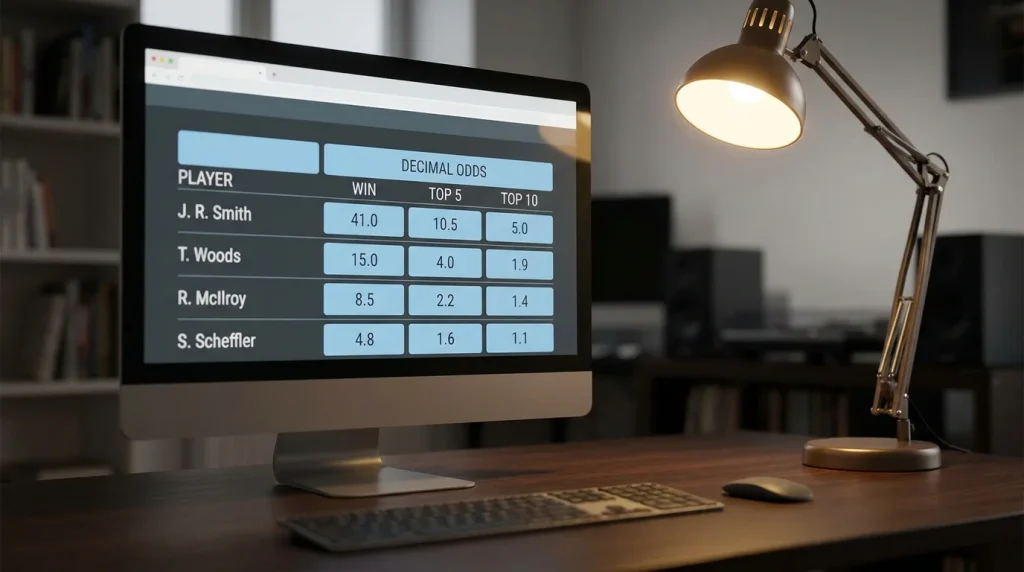
The first time I used a betting exchange, the odds looked wrong. A player I expected to see at 40/1 was listed at 41.0. It took me an embarrassing few minutes to realise the exchange was displaying decimal odds — the format used across continental Europe, betting exchanges, and increasingly by online sportsbooks worldwide. Online sports betting now accounts for 68% of new registrations and wagering activity globally, and that shift toward digital platforms has made decimal odds the de facto international standard.
Decimal odds express the total return on a GBP1 stake, including the stake itself. A decimal price of 41.0 means a GBP1 bet returns GBP41 total — which is exactly the same as 40/1 in fractional format. The only difference is that the fractional version separates profit from stake, while the decimal version bundles them together.
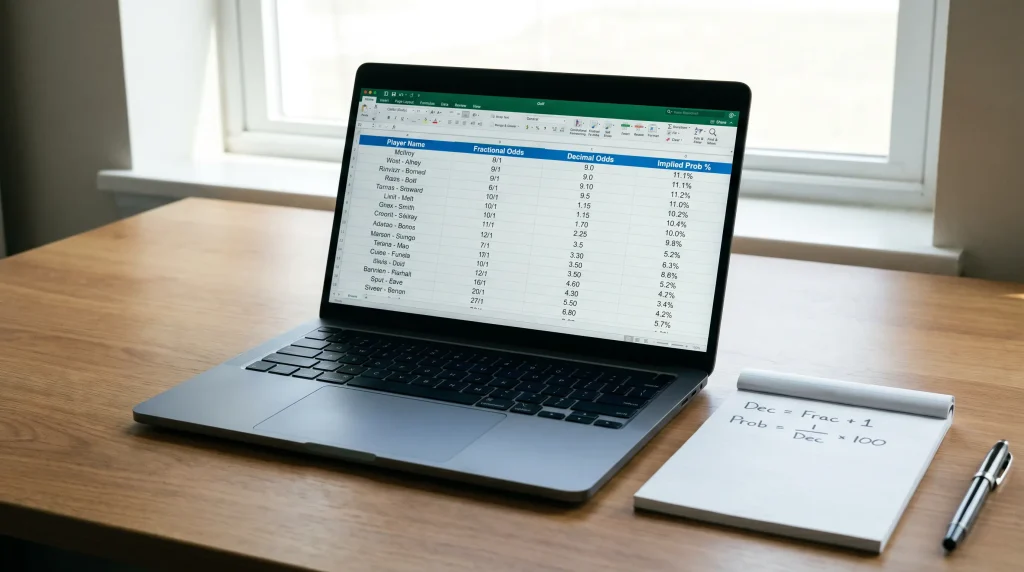
Converting between the two is simple. To go from fractional to decimal: divide the numerator by the denominator and add 1. So 40/1 becomes (40 / 1) + 1 = 41.0. And 9/2 becomes (9 / 2) + 1 = 5.5. To go from decimal to fractional: subtract 1 from the decimal price and express the result as a fraction. Decimal 5.5 becomes 4.5/1, which is conventionally written as 9/2.
Decimal odds have one clear advantage for golf bettors: they make comparison easier. When you are scanning a list of 156 players across three different bookmakers, decimal prices line up neatly in a column and the highest number is always the best price. Fractional odds require mental arithmetic to compare — is 33/1 better or worse than 28/1? Obviously yes, but is 15/2 better or worse than 8/1? Both return roughly GBP8 per pound staked, and spotting the difference at a glance is harder in fractional format than in decimal (8.5 vs 9.0).
Most UK sportsbooks let you toggle between fractional and decimal in the settings. I recommend switching to decimal when you are comparing prices across operators, then switching back to fractional if that is what feels natural for placing bets. The format you use does not change the value of the bet — only the clarity of the comparison.
Implied Probability and Overround: What the Odds Really Say
Here is where odds stop being a payout table and start being a tool. Every set of odds contains a hidden probability estimate — the bookmaker’s assessment of how likely a particular outcome is. Extracting that estimate is the single most important skill in golf betting, because it turns a passive number into something you can argue with.
The global sports betting market, valued at roughly $162.53 billion in 2025 and projected to grow to $575.45 billion by 2035, runs entirely on this principle: bookmakers set prices that reflect probability plus a margin, and bettors try to find where those probabilities are wrong. In golf, where the fields are large and the variables are many, the margin for error is wider than in most sports — which means the opportunities for a well-prepared punter are real.
Implied probability is what the odds say about a player’s chance of winning after you strip out the payout mechanics. It answers a simple question: according to this price, how often would this player need to win for the bet to break even?
The overround — sometimes called the “vig” or “juice” — is the bookmaker’s profit margin, baked into the odds. If you add up the implied probabilities for every player in a golf outright market, the total will exceed 100%. A typical golf outright market runs between 120% and 140%. That surplus is the overround. It means that every bet in the market is priced slightly shorter than the bookmaker’s true probability estimate, and the cumulative effect is a guaranteed margin for the house regardless of who wins.
Understanding the overround is not about complaining that the game is rigged. It is about knowing the size of the headwind you are running into. An overround of 130% means you need to be approximately 30% more accurate than the bookmaker’s probabilities to break even. That sounds daunting, but in a market with 156 runners where each player’s probability is tiny, being 30% more accurate on a small number of targeted selections is achievable — especially if you focus your analysis on the middle of the market where bookmakers allocate less attention to pricing.
Step-by-Step Implied-Probability Calculations
The formula for converting fractional odds to implied probability is: denominator / (numerator + denominator) x 100. For a player at 40/1: 1 / (40 + 1) x 100 = 2.44%. For decimal odds: (1 / decimal price) x 100. Decimal 41.0: (1 / 41.0) x 100 = 2.44%. Same result, different route.
Let me run through a realistic set of golf odds to show how this works in practice. Suppose the favourite for a PGA Tour event is priced at 9/1 fractional (10.0 decimal). His implied probability is 1 / 10 x 100 = 10%. The second favourite is 14/1 (15.0): implied 6.67%. A mid-field player at 50/1 (51.0): implied 1.96%. And a long shot at 125/1 (126.0): implied 0.79%.
Now, add those up across the entire field. If you summed every player’s implied probability, you would get something like 130%. That 30% surplus is the overround. To find the “true” implied probability without the margin, you can normalise by dividing each player’s implied probability by the total and multiplying by 100. The favourite’s 10% becomes 10 / 130 x 100 = 7.69%. The 50/1 shot’s 1.96% becomes 1.51%. These normalised figures represent the bookmaker’s actual probability estimates, stripped of margin.
This matters for one reason: comparing your probability estimate against the normalised number tells you whether you have an edge. If you believe the 50/1 player has a 3% chance of winning and the normalised implied probability is 1.51%, the gap is 1.49 percentage points — a substantial edge at these odds. If you believe he has a 1.2% chance, you are actually behind the bookmaker’s estimate, and the bet is negative value regardless of how appealing the price looks on the surface.
I run this calculation for every player on my shortlist, every week. It takes ten minutes with a spreadsheet and saves me from placing bets where the maths is working against me.
Comparing Odds Across Bookmakers: What to Look For
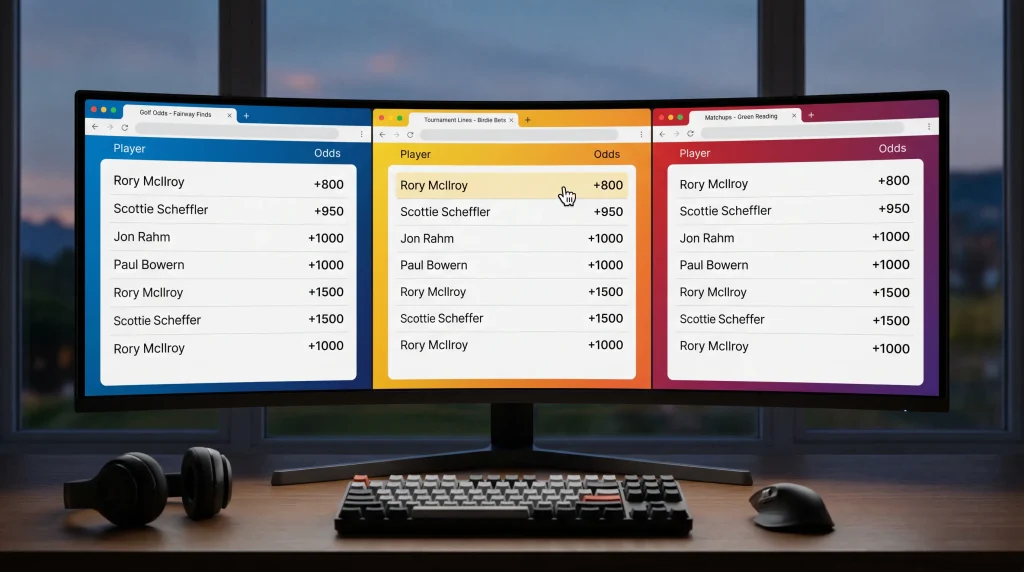
Two years into golf betting, I realised I had been leaving money on the table every single week by not comparing prices. I would find a player I liked, open my usual sportsbook, and place the bet — without checking whether the same player was available at a better price elsewhere. The difference between 40/1 and 45/1 on a GBP5 each-way bet is GBP12.50 on the place half alone. Multiply that across a season and the lost value is substantial.
The UK has 8,148 licensed gambling premises, including 5,669 bookmaker shops, and dozens of online operators competing for your business. That competition produces price variation — the same player, in the same tournament, can be priced at 33/1 with one operator and 40/1 with another. The gap is not a mistake. It reflects different risk models, different liability positions, and different customer profiles. Your job is to exploit those gaps, not to understand why they exist.
Price comparison in golf is more impactful than in most sports because the odds are long and the margins are wide. In a football match where one team is 6/5 and another sportsbook offers 11/8, the difference in payout on a GBP10 bet is GBP1.75. In golf, the same percentage difference at 40/1 vs 45/1 on a GBP10 bet is GBP50 in potential return. The absolute gap in returns is much larger at longer odds.
I use three operators for the majority of my golf betting, chosen specifically for their golf market coverage and place terms rather than for any promotional reason. For a broader look at what to weigh when choosing where to bet, I have written a separate comparison of golf betting sites in the UK by market depth and each-way terms. The selection criteria matter — an operator with better odds but only three each-way places might be worse overall than one with slightly shorter odds but five places.
The habit of checking two or three operators before placing any golf bet is the simplest, most reliable way to improve your long-term returns. It requires no analytical skill, no model, and no expertise. It just requires the discipline to look before you click.
Odds Movement: Why Golf Prices Shift and What It Signals
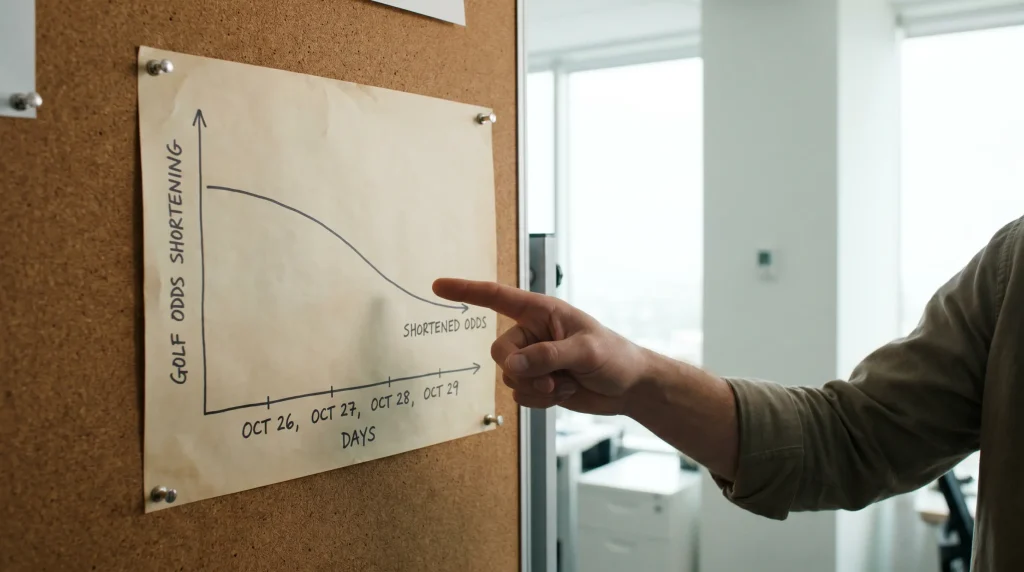
Golf odds are not static. From the moment a market opens on Monday or Tuesday to the first tee shot on Thursday morning, prices move — sometimes dramatically. A player priced at 50/1 on Tuesday might drift to 66/1 by Wednesday evening, or shorten to 33/1 if money pours in. Those movements tell a story, and learning to read them is a skill that separates informed punters from passive ones.
The PGA Tour expanded its live betting coverage in 2026 to over 400 hours across 12 tournaments, partnering with ESPN and DraftKings in what Scott Warfield, the Tour’s Vice President of Gaming, called a significant step in fan engagement. That expansion signals a broader shift: golf is becoming a more data-rich, more actively traded betting market, and the odds are reflecting information faster than they did even two years ago.
Pre-tournament odds movement happens for three main reasons. The first is information: a player withdraws, a practice-round report surfaces suggesting someone is struggling with an injury, or a weather forecast shifts and alters the conditions. The second is market weight: a high-volume bettor or a syndicate backs a player, and the bookmaker shortens the price to manage liability. The third is book balancing: the bookmaker adjusts prices across the field to ensure a roughly even margin regardless of the outcome.
For a punter, the practical question is: should I bet early or late? Early betting captures the opening price before the market has absorbed new information. Late betting benefits from the most up-to-date conditions and field data. I lean toward early for players where my conviction is highest and the opening price feels generous, and late for players where I want to see the final tee times and weather before committing. There is no universally correct timing — only the discipline to decide before you look at the market rather than reacting to what the market is doing.
One pattern I have noticed over seven years: golf odds tend to shorten on well-known players and drift on lesser-known ones as tournament week progresses. The recreational money flows toward the names, which compresses prices on favourites and pushes value toward the middle and lower tiers of the market. Tuesday evening, after the field is confirmed but before the recreational rush begins on Wednesday, is often the sweet spot for finding the best available price on a mid-tier selection.
Contextual Clues: Weather, Withdrawals and Market Reaction
Odds do not move in a vacuum. Behind every price shift is a contextual trigger, and in golf, three triggers dominate: weather changes, player withdrawals, and market overreaction.
Weather is the most common and most impactful. A wind forecast that jumps from 10 mph to 25 mph for Thursday afternoon will lengthen the odds on every player in the afternoon wave and shorten prices on morning starters. This movement is rational — wind genuinely changes scoring conditions — but it is often overdone. A 25 mph forecast might soften to 18 mph by Thursday morning, and the prices do not always snap back. If you monitor the weather forecast more actively than the market does, you can find value in the gap between the forecast that moved the odds and the updated forecast that has not yet been priced in.
Withdrawals create sudden, visible price shifts. When a top-10 player pulls out of a tournament, the remaining contenders’ odds shorten because the field has weakened. This makes intuitive sense, but the magnitude of the adjustment is sometimes disproportionate. The withdrawal of one player from a 156-player field changes each remaining player’s win probability by a fraction of a percentage point. If the market shortens a player from 40/1 to 33/1 purely because a single high-ranked competitor withdrew, the overreaction can create value on the other side — players whose odds have drifted or remained static despite the slightly easier field.
Market overreaction is hardest to spot but most profitable to exploit. It happens when money floods toward a narrative — a player returning to a course he won at previously, a popular name coming off a high-profile finish — and the odds compress beyond what the data justifies. The antidote is always the same: run the implied probability calculation, compare it to your own estimate, and trust the numbers over the noise.

Golf Betting Odds: Frequently Asked Questions
Why do golf odds vary so much between bookmakers?
Each bookmaker uses its own risk model and manages its own liability. A sportsbook with heavy customer exposure on a particular player will shorten that player"s price to reduce risk, while another operator with less exposure on the same player may leave the price unchanged. These differences create price variation across the market, which is why comparing odds across multiple operators before placing a bet is essential.
What does "odds-on" mean in a golf matchup bet?
Odds-on means the payout is less than the stake — the player is considered more likely to win the bet than to lose it. In fractional terms, the denominator is larger than the numerator (e.g. 4/7). In decimal terms, the price is below 2.0. Odds-on is common in golf matchup markets where one player is significantly stronger than the other.
How do I convert fractional golf odds to decimal quickly?
Divide the first number by the second and add one. For example, 40/1 becomes 40 divided by 1 plus 1, which equals 41.0. For 9/2, divide 9 by 2 to get 4.5, then add 1, giving 5.5. This works for any fractional price.
What is a typical overround for a golf outright market?
Golf outright markets typically run an overround between 120% and 140%. This means the sum of all implied probabilities exceeds 100% by 20 to 40 percentage points, which represents the bookmaker"s built-in margin. Markets with more runners tend to carry higher overrounds than smaller fields.
Read the Number Before You Back the Name
Every golf bet you place begins with a number on a screen. That number is not just a potential payout — it is a claim about probability, a reflection of market forces, and an invitation to disagree. The punters who treat odds as a language to be learned, rather than a decoration to be accepted, are the ones who find consistent value in a market that rewards precision over popularity.
Learn to convert, learn to compare, and learn to calculate implied probability. Those three skills cost nothing to acquire and pay for themselves within weeks.
Articles
Written by the editors at Golf Betting Tips.
