
Golf Outright Betting Tips: Evaluating Tournament Winner Markets Before the First Round
 Available in US
I’ve backed exactly nine outright tournament winners in seven years of serious golf betting. Nine. That works out to roughly 1.3 winners per season across 40-plus events. The strike rate sounds awful until you consider the prices: 28/1, 40/1, 55/1, 66/1 among them. Those nine winners, at those prices, represent the most profitable segment of my entire betting record. Outright betting in golf is a patience game measured in months, not weeks — and the punters who can’t stomach the long losing runs between paydays never survive long enough to collect.
The PGA Tour’s betting handle grew 20% in 2025, and outright winner markets absorbed the largest share of that increase. These are the headline markets, the ones bookmakers promote on their homepages and the ones that generate the biggest payouts. They’re also the hardest to beat, because the implied probability on any individual player is so low that your edge needs to be precisely calibrated. This isn’t a market for guesswork.
What Outright Winner Betting Involves
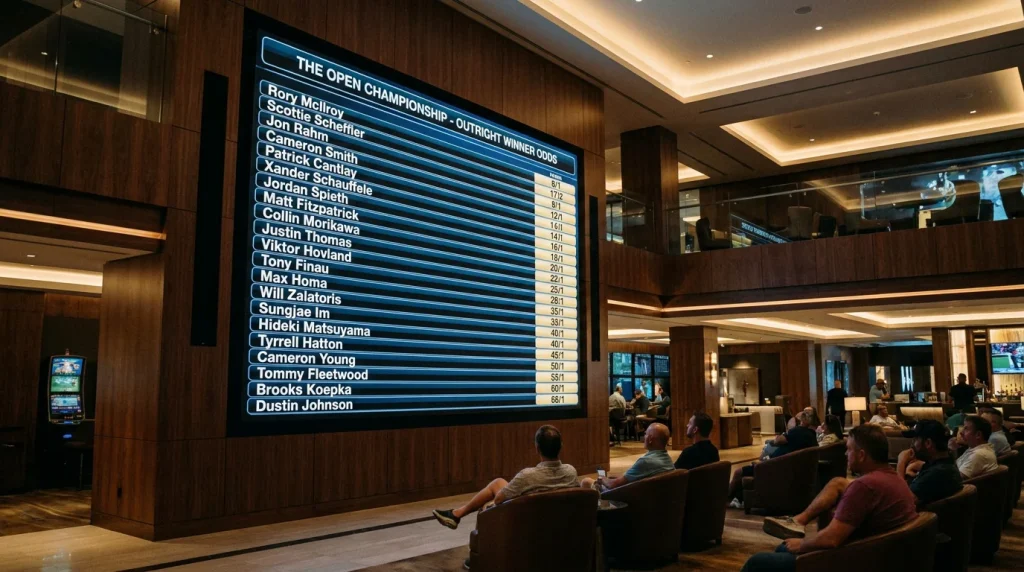
An outright bet is a wager on a single player to win the tournament. You’re picking one name from a field of 70 to 156 players, and unless that name finishes in first place — or shares first and wins a play-off — the bet loses. No place consolation, no partial payout, no moral victories. The binary nature is what creates the long odds: a field of 156 mathematically means no player can have an implied probability above 0.64% without the bookmaker pricing others at even more extreme levels. In practice, tournament favourites sit at 8/1 to 14/1 for regular events and 6/1 to 10/1 for majors. Everyone else stretches to 100/1 and beyond.
The global sports betting market sits at roughly $162.5 billion in 2025, and golf outrights represent one of the purest forms of value betting within it. The large field sizes create pricing inefficiencies that simply don’t exist in two-outcome sports like tennis or in football matches where three results dominate. The bookmaker has to price 156 outcomes simultaneously, and getting all of them right is impossible. Your job is to find the handful they’ve got wrong.
Ante-Post vs Day-of-Tournament Odds
This is a decision I face every single week: do I bet early in the week when odds are longer but information is incomplete, or do I wait until Thursday morning when I know the draw, the weather forecast and the final field? Both approaches have structural advantages, and my answer is usually “both” — but for different players.
Ante-post odds — prices posted before the tournament field is finalised, sometimes weeks in advance — offer longer prices because the bookmaker builds in a margin for uncertainty. A player might be 33/1 on Monday and 25/1 by Thursday. That drift reflects new information (practice rounds, fitness updates, draw analysis), but it also reflects the market adjusting to the weight of money from other bettors. If your analysis is complete by Monday — if you’ve run the course-fit profile, checked the strokes gained data and assessed the form window — there’s genuine value in betting early, because the information you’ve processed is worth more than the uncertainty premium the bookmaker has baked in.
The risk is non-runners. If you back a player ante-post and they withdraw, your stake is typically lost. Some bookmakers offer non-runner money-back guarantees on golf outrights, but these usually come at shorter odds. I split my outright allocation: 60% placed on Thursday morning after the draw is published, and 40% placed ante-post on Monday or Tuesday for players whose odds I expect to shorten significantly. The ante-post portion is limited to players I’ve verified as committed to the event through official entry lists.

Narrowing the Field: A Five-Filter Process
Every week, I start with the same question: out of 156 players, how do I get to a shortlist of 8-12 names worth serious analysis? The answer is a five-filter process I’ve refined over several seasons. Each filter eliminates a chunk of the field, and only players who pass all five make it to the final card.

Filter one: course-fit profile. I’ve built statistical profiles for every regular PGA Tour and DP World Tour venue based on which strokes gained categories correlate most strongly with top-10 finishes over the last five years. Players whose SG profiles don’t match at least two of the top three demanded categories are eliminated. This alone removes 60-70% of the field. The FedEx Cup Playoffs saw handle rise 50% year-on-year in 2025 — and that increase has made course-fit profiling more important, not less, because sharper markets mean you need a genuine edge to find value.
Filter two: form window. I look at strokes gained tee-to-green over the most recent 24 rounds. Players trending downward — losing half a stroke or more from their 24-round average compared to their 12-round average — get cut. This isn’t about punishing one bad week; it’s about identifying genuine form declines versus short-term variance.
Filter three: field-strength adjustment. A player who’s been posting strong numbers in weak-field DP World Tour events faces a very different test in a PGA Tour signature field. I adjust my form assessments based on the average OWGR ranking of the fields they’ve been competing in. Strong results against weaker opposition get discounted.

Filter four: health and schedule. Players returning from injury or playing their fourth consecutive week are at elevated risk of underperformance. This is qualitative rather than statistical, but it matters — fatigue and fitness are real factors that models underweight.
Filter five: price check. Only after the first four filters produce a shortlist do I look at odds. If a player passes all four analytical filters but the price doesn’t exceed my estimated fair odds by at least 20%, there’s no bet. Value is the gap between my probability estimate and the bookmaker’s, and that gap has to be wide enough to overcome the built-in overround.
Pairing Outrights with Each-Way Cover
The most common way UK punters engage with outright golf markets is through each-way betting, which pairs the outright win bet with a place bet at a fraction of the odds. I use each-way for almost all my outright selections because the place half provides a return pathway that the win-only bet doesn’t offer. A player who finishes fourth at 40/1 each-way, with 1/4 odds for five places, still returns a meaningful profit on the place half despite losing the win half.
The tactical question is when to bet each-way versus win-only. My rule: if the each-way terms offer five or more places at 1/4 odds, and my model suggests the player has a top-5 probability above 15%, each-way is the default. If the player is a short-priced contender at 10/1 or less, win-only often delivers better expected value because the place fraction at those odds produces thin returns.
Outright Golf Betting: Common Questions
How early should I place an outright golf bet?
It depends on your information advantage. If your analysis is complete and you expect the odds to shorten by Thursday, ante-post betting on Monday or Tuesday captures longer prices. If you rely on draw, weather or late field changes, wait until Thursday morning. Many sharp bettors split their allocation between early and late placements.
What happens to an outright bet if my golfer misses the cut?
The bet loses. Outright bets require the player to win the tournament outright, and a missed cut means they cannot finish first. Each-way bets provide partial protection because the place half can pay out if the player finishes in the covered positions, but missing the cut eliminates both halves. Some bookmakers offer insurance promotions refunding stakes if a player misses the cut by one stroke, but these are promotional offers, not standard terms.
Articles
Written by the editors at Golf Betting Tips.
