
Golf Betting Mistakes to Avoid: Twelve Errors That Drain Bankrolls Season After Season
 Available in US

I’ve made every mistake on this list. Some of them I made for an entire season before the tracking data forced me to confront what was happening. The most expensive one — increasing my stakes after a hot streak — cost me four months of profit in three weeks during the 2021 FedEx Cup Playoffs. The most insidious one — backing players based on name recognition rather than data — took two full seasons to identify because the losses were small and spread across so many bets that the pattern was invisible without granular market-by-market tracking. These aren’t hypothetical errors. They’re scars, and sharing them is more useful than pretending they didn’t happen.
The PGA Tour recorded a 20% increase in golf betting handle in 2025, which means more punters are entering a market where these mistakes are structurally costly. Golf’s large fields, long odds and seasonal timelines amplify the damage from staking errors and selection biases in ways that shorter-odds sports don’t. A mistake that costs you 2% of your bankroll in football betting can cost you 8-10% in golf because the variance is higher and the recovery window is longer.
Selection Errors: Bias, Name Recognition and Narrative Traps
The first category of mistakes happens before you even look at odds. These are errors in how you choose which players to evaluate, and they contaminate every bet that follows.

Name recognition bias is the most common. You’ve heard of this player, seen them on TV, read about them in a headline. That familiarity creates a false sense of knowledge that tricks your brain into overestimating their probability of winning. The data is unambiguous: the most-backed players in golf outright markets — the ones who attract the most public money — have a collective ROI of roughly negative 8-12% over time. They’re not bad players; they’re overpriced because the market has already compressed their odds to reflect their popularity.
Narrative bias is subtler. “He’s due for a win.” “This course suits him because he grew up on links.” “He always plays well after a missed cut.” These stories feel persuasive, but they’re post-hoc rationalisations, not predictive indicators. I spent my first season betting heavily on narrative-driven selections and finished the year down 11%. When I switched to a purely data-driven shortlist — course-fit profiles and strokes gained filters with no room for storylines — my ROI turned positive within three months.
The fix for both biases is structural: build your shortlist without looking at player names. Seriously. I filter the field by statistical profile first, producing a list of anonymous player IDs ranked by course-fit score. Only after the shortlist is complete do I reveal the names and check the odds. This process eliminates the unconscious pull of familiarity and forces every selection to earn its place through data alone.
Staking Errors: Overbetting, Chasing and Emotional Wagers
The problem gambling rate among UK adults sits at 2.7% as measured by the PGSI, and staking errors are often the first behavioural marker that separates disciplined bettors from those heading toward trouble. The three staking mistakes I see most frequently — and have made myself — are overbetting after wins, chasing after losses, and emotional side bets.

Overbetting after wins is paradoxically more dangerous than overbetting after losses, because it feels justified. You’ve been winning, so your model must be working, so why not increase the stakes? The answer is that short-term winning in golf is consistent with both genuine edge and pure luck, and you can’t distinguish between them until the sample size reaches 200+ bets. Increasing stakes based on a 30-bet winning streak is treating noise as signal.
Chasing after losses is the mirror image and the faster route to bankroll destruction. A losing week in golf is structurally normal — even a well-calibrated model will produce losing weeks 60% of the time because the strike rate on outright bets is below 5%. The impulse to bet more heavily in the following week to “recover” the losses ignores the maths entirely and converts a normal drawdown into an accelerating spiral.
Emotional side bets are the third staking trap. You’re watching the tournament on Sunday, your outright pick has missed the cut, and you impulsively back a player in-play because the leaderboard looks exciting. That bet wasn’t in your plan, wasn’t in your analysis, and wasn’t in your staking allocation. It’s entertainment spending disguised as strategy, and it erodes the discipline that separates profitable bettors from everyone else. For a structured approach to protecting against these impulses, my guide to bankroll management provides the mechanical framework.
Process Errors: Ignoring Data, Skipping Reviews and Market Tunnel Vision
Process errors are the quietest category because they don’t produce dramatic single-bet losses. They produce a slow, steady erosion of edge that becomes visible only in quarterly or annual reviews. Nearly 30% of regular golf bettors don’t track their results at all — they have no idea whether they’re profitable, which markets are working, or where their process is failing. Betting without tracking is walking without a map: you might arrive somewhere interesting, but you can’t retrace your steps or avoid the dead ends next time.
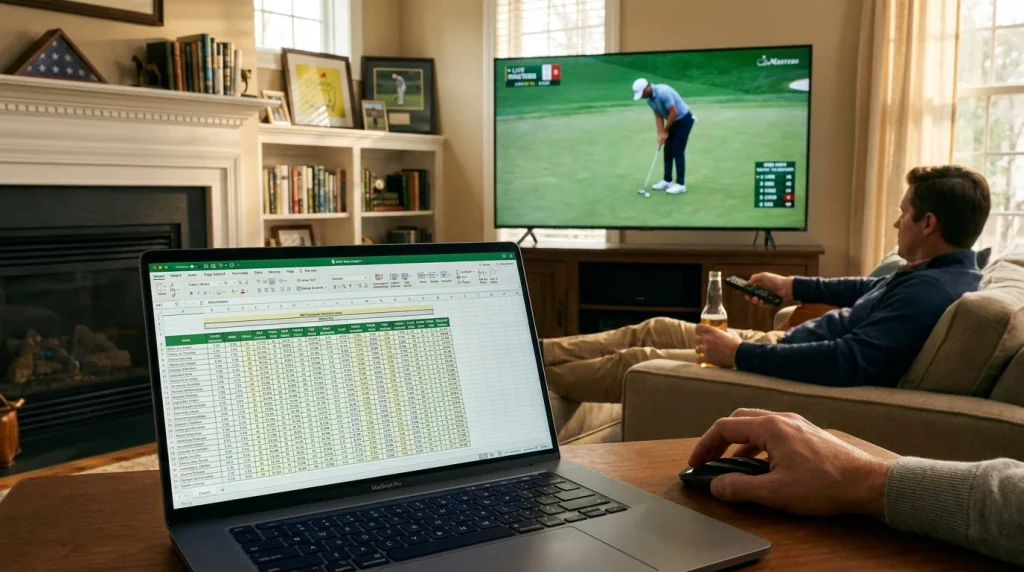
Skipping the weekly review is a related error. Every Sunday evening, I spend 30 minutes reviewing the week’s bets: which selections hit, which missed, and why. The “why” is the crucial element. A bet that lost because the player was outperformed by the field is different from a bet that lost because my course-fit profile was wrong. The first is variance; the second is a model error that I can fix. Without the review, both look the same in the spreadsheet.
Market tunnel vision — betting exclusively on outright winners when your edge is actually in matchups, or ignoring top-finish markets because outrights feel more exciting — is the process error that took me longest to fix. My tracking data showed a clear pattern after two seasons: positive ROI on matchups and top-10 finishes, negative ROI on outrights above 50/1. Instead of accepting that my edge lived in one part of the market and not another, I kept betting outrights because the payouts were more exciting. Exciting is not profitable. Follow the data, not the dopamine.

Golf Betting Mistakes: Common Questions
What is the biggest mistake new golf bettors make?
Betting on players based on name recognition rather than statistical analysis. Popular, well-known players attract the most public money, which shortens their odds below fair value. The most-backed players in golf outright markets collectively produce a negative ROI of 8-12% over time. The fix is to build your shortlist using data-driven course-fit profiles before checking player names or odds.
How do I stop chasing losses when betting on golf?
Set mechanical stop-loss rules before the season starts: a specific bankroll drawdown percentage that triggers reduced staking or a full pause. Write these rules down and follow them without negotiation. Chasing losses in golf is especially destructive because losing weeks are structurally normal — even strong models produce losing weeks 60% of the time. Accepting that variance rather than fighting it is the psychological shift that separates sustainable bettors from those who burn out.
Articles
Published by the Golf Betting Tips team.
