
Golf Betting Data and Technology: Providers, Tools and How Live Feeds Reach Your Sportsbook
 Available in US

The first time I watched live golf odds move in real time on a betting exchange, I assumed there was a person somewhere updating numbers by hand. That was a decade ago. The reality is that between the moment a ball lands on a green and the moment your sportsbook adjusts its in-play odds, a chain of technology fires that most punters never see and rarely think about. Understanding that chain — who captures the data, who processes it, who distributes it and how fast it arrives — is the difference between betting with context and betting blind.
The global sports betting market sits at roughly $162.5 billion in 2025, projected to reach $575 billion by 2035. Golf’s slice of that figure is growing faster than nearly every other individual sport, and the technology infrastructure fuelling that growth has become the invisible foundation beneath every bet you place.
Key Golf Data Providers: ShotLink, Sportradar and Tour APIs
I remember the first season I started using strokes gained data for my weekly selections. The improvement was immediate — not because the data gave me guaranteed winners, but because it eliminated entire categories of bad bets from my process. That data exists because of ShotLink, the PGA Tour’s proprietary shot-tracking system that has been capturing ball position, distance and outcome on every single shot at every PGA Tour event since 2003. Over two decades of granular shot-level data on thousands of players across hundreds of courses. Nothing else in professional sport comes close to that depth of publicly accessible performance data.

ShotLink uses a combination of laser rangefinders and volunteer spotters at each event. Every tee shot, approach shot, chip and putt is logged with precise coordinates and distance measurements. That raw data feeds directly into the strokes gained framework — the analytical backbone of modern golf betting. Without ShotLink, strokes gained as a practical betting tool wouldn’t exist. Every course-fit profile, every form analysis, every model that sharp golf bettors build rests on this foundation.
Sportradar sits on the distribution side. They’re the official data partner for the PGA Tour’s betting data, which means every live scoring feed, every real-time leaderboard update and every shot-by-shot data stream that reaches your sportsbook runs through their infrastructure. When you see in-play odds adjust within seconds of a birdie putt dropping, that speed exists because Sportradar’s systems are pushing data to bookmakers’ pricing engines with minimal latency.
The PGA Tour also offers its own API access for approved partners, providing historical and live scoring data that developers and analysts can integrate into custom tools. For the average punter, you won’t be connecting directly to these APIs. But the tools you do use — from free statistical websites to paid prediction platforms — are built on data that flows from ShotLink through Sportradar and the Tour’s data partnerships. Understanding the supply chain matters because it explains why PGA Tour data is so much richer than data from other tours, and why betting on events outside the PGA Tour’s ShotLink coverage requires a fundamentally different analytical approach.

PGA Tour LIVE Betcast: How 400+ Hours of Coverage Changed In-Play
Something shifted in golf betting during the 2025-2026 season that I think most punters haven’t fully absorbed yet. PGA Tour LIVE Betcast expanded from 50 hours across 6 tournaments in 2025 to over 400 hours across 12 tournaments in 2026 — a 700% increase. That’s not a marginal improvement. That’s a format change.
Before Betcast, in-play golf betting operated on a significant information delay. You watched standard broadcast coverage, which follows the leaders and notable stories. The player you’d backed at 66/1 might be three under through 12 holes and you wouldn’t know about it until a brief leaderboard flash between commercial breaks. Betcast changes that equation by providing shot-level coverage specifically designed for bettors, with odds integration, statistical overlays and real-time data on players across the entire field — not just the ones the broadcast director finds interesting.
For in-play betting, this expansion matters in two specific ways. First, you can now watch the shots that drive your bets. A player’s approach shot quality, green-reading tendencies and body language under pressure are visible in real time rather than filtered through a leaderboard number. Second, the market reacts faster because more participants have access to the same visual information simultaneously. That compression of the information gap means in-play edges are shorter-lived but potentially more frequent — the market adjusts quickly after each shot, but the number of adjustment events per round has increased dramatically.
The practical question for UK punters is access. Betcast coverage is primarily distributed through US-facing platforms, and availability in the UK depends on your sportsbook’s broadcasting partnerships. Check whether your operator offers live streaming of PGA Tour events — not all do, and those that don’t leave you betting in-play without the most important data source available.

Free and Paid Tools for Golf Bettors
When I started taking golf betting seriously, I spent nothing on data tools. Everything I used was free — PGA Tour’s own website for scoring data, a basic spreadsheet for tracking my bets, and publicly available strokes gained tables. That setup was enough to be profitable for two seasons. The free tier in golf betting analysis is remarkably strong compared to other sports. The PGA Tour publishes detailed statistical tables on its website covering driving distance, accuracy, greens in regulation, strokes gained categories and historical results by course. Europe accounts for 41% of the global sports betting market, and UK-based punters have access to all of this data without paying a penny.
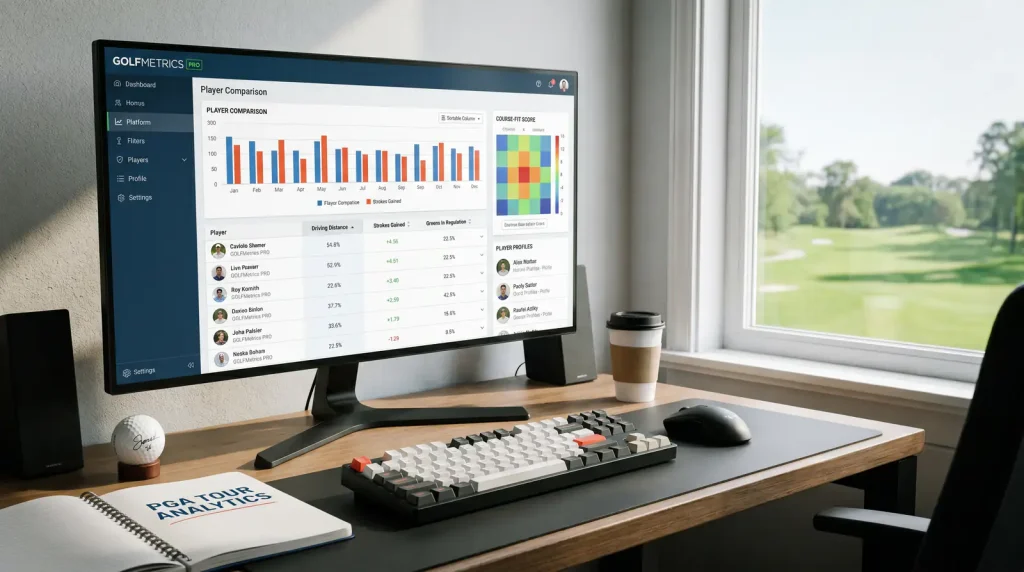
Paid tools add efficiency rather than access. Platforms like Data Golf and Fantasy National Golf Club offer pre-built models, customisable course-fit profiles and automated data aggregation that saves hours of manual spreadsheet work each week. Data Golf’s model, in particular, has a public track record that you can verify — they publish their pre-tournament predictions and you can check how they’ve performed over multiple seasons. The cost ranges from free tiers with limited features to premium subscriptions in the range of £10-30 per month.
The question isn’t whether paid tools are “worth it” in the abstract. It’s whether the time they save exceeds the subscription cost when measured against your staking level. If you’re betting £5 per selection across four markets per week, a £25 monthly subscription needs to improve your ROI by a substantial margin to justify itself. If you’re betting at higher levels and spending several hours per week on manual data analysis, the calculation flips. I moved to a paid tool in my third season and the primary benefit wasn’t better picks — it was consistent picks, because the tool eliminated the weeks where I’d skip the analysis out of laziness and bet on instinct instead.
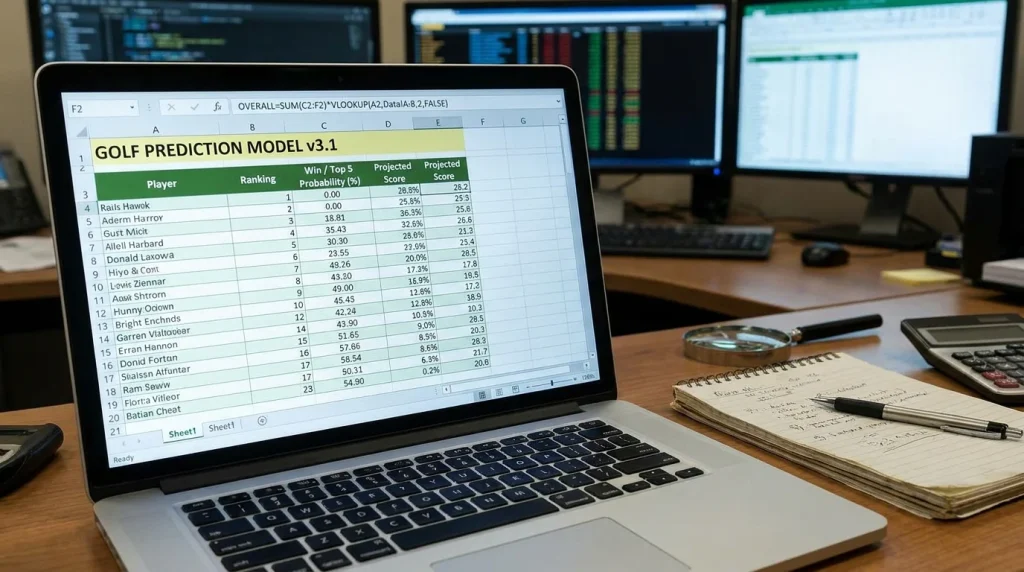
Custom model building sits at the other end of the spectrum. If you know Python or R, the combination of free PGA Tour data and a basic statistical modelling framework can produce a bespoke tool that no subscription service replicates. The investment is time, not money — typically 30-50 hours to build a working prototype and ongoing maintenance each season as data formats and access points evolve.
Golf Betting Technology: Common Questions
What is ShotLink and how does it help golf bettors?
ShotLink is the PGA Tour"s shot-tracking system that has captured data on every shot at every PGA Tour event since 2003. It records ball position, distance and outcome for every tee shot, approach, chip and putt. This data feeds the strokes gained framework that sharp golf bettors use for course-fit profiling, form analysis and predictive modelling. Without ShotLink, the analytical depth available for PGA Tour betting would not exist.
Are predictive models useful for amateur golf punters?
Yes, but expectations need calibrating. No model predicts golf tournament winners consistently — the sport is too variable. What a good model does is identify players whose true probability of a result exceeds the implied probability in the odds, which is where value lives. Free data from the PGA Tour website combined with a basic spreadsheet is enough to start. Paid platforms add efficiency. Custom models built in Python or R offer the most flexibility but require significant time investment.
Articles
Prepared by the Golf Betting Tips editorial staff.
