Golf Dead Heat Rules Explained: How Tied Finishes Reduce Your Payout
 Available in US
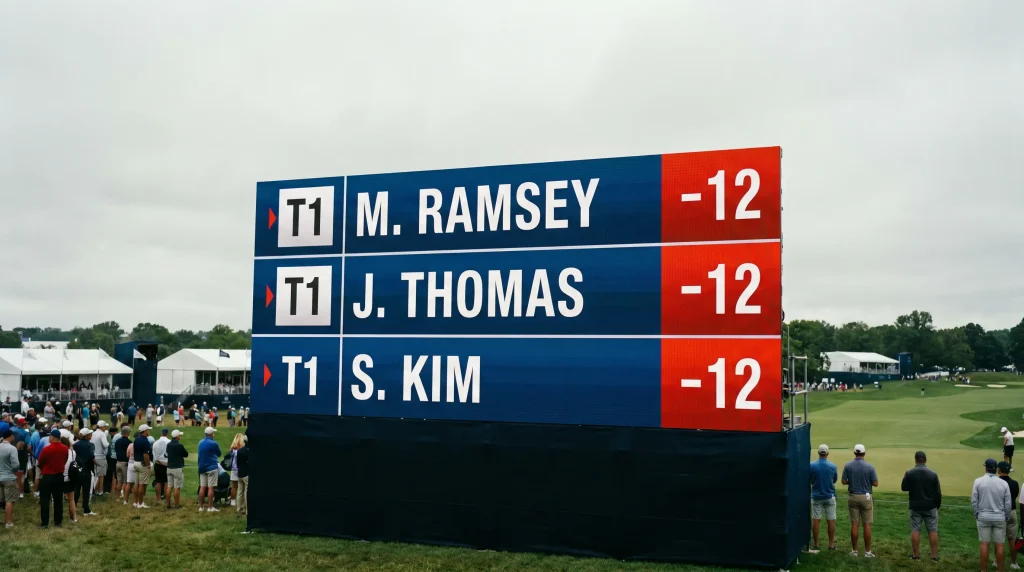
The first time a dead heat cost me real money, I didn’t even understand what had happened. I’d placed a top-5 each-way bet at 20/1 on a player who finished tied for fifth with two others. I expected the place half to pay 5/1 — a quarter of the 20/1 outright odds. Instead, the payout was roughly a third of that, and my account statement showed a calculation I’d never seen before. That confusion cost me three months of misunderstanding how my returns were being calculated, and it’s the reason dead heat rules are now the first topic I explain to anyone entering golf betting.
Ties are not rare in golf. They’re structurally inevitable. In a field of 156 players competing over 72 holes, multiple players finishing on the same score at any given position is the norm, not the exception. The UK sports betting market generates approximately £2.48 billion in annual gross gaming yield, and a meaningful portion of that figure is affected by dead heat calculations that most punters have never properly learned.
How the Dead Heat Rule Divides Your Stake
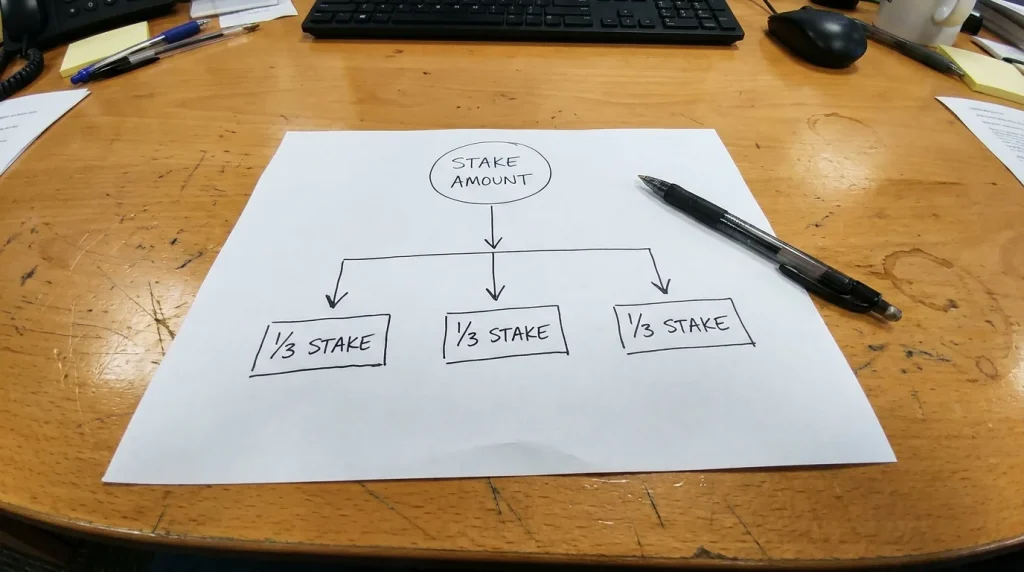
The dead heat rule operates on a simple principle: your stake is divided by the number of players sharing the position that triggers your payout. If three players are tied for a spot that affects your bet, your effective stake becomes one-third of what you wagered. The odds remain the same; only the stake changes. This means the payout is always lower than you’d receive without the tie — and in multi-way dead heats, it can be dramatically lower.
Let me make this concrete. Suppose you place a £10 each-way bet on a player at 40/1 with 1/4 odds for five places. The place half of your bet is £5, and if your player finishes outright fifth, that half pays £5 x (40/4) = £5 x 10 = £50 plus your £5 stake back. Total place return: £55. Net profit from the place half: £50 minus the £10 total stake = a £40 net gain (since the win half lost).
Now apply the dead heat. Your player finishes tied for fifth with two other golfers — a three-way tie. Your £5 place stake is divided by three, giving an effective stake of £1.67. The payout is £1.67 x 10 = £16.67 plus your effective stake of £1.67 returned = £18.34. Net result across the full bet: £18.34 minus £10 total stake = a £8.34 profit. The dead heat turned a £40 profit into an £8.34 profit. Same finishing position, same odds, radically different return.
Dead Heats in Place, Top-Finish and FRL Markets
Dead heats affect every golf market where a finishing position determines the payout threshold. The most common scenarios I encounter fall into three categories.
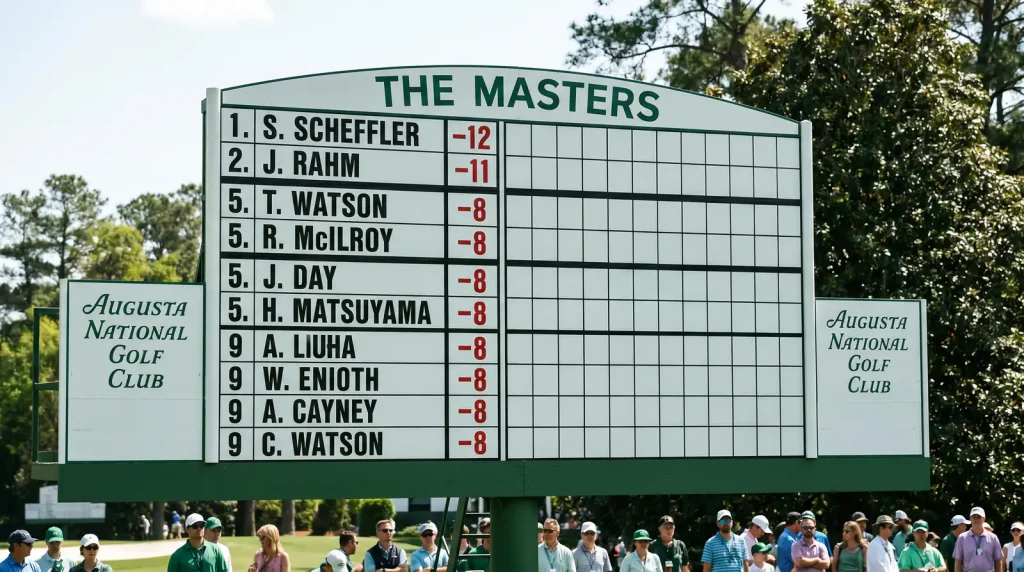
In each-way place markets, dead heats occur when players tie for the last covered position. If your bookmaker pays five places and four golfers share fifth place, all four are subject to the dead heat rule. Your stake is divided by four, and the return shrinks accordingly. This is the scenario that catches the most punters off guard because the each-way bet looked like a winner until the dead heat reduction hit.
In top-finish markets — top 5, top 10, top 20 — dead heats apply at the boundary. A top-10 bet is affected when multiple players tie for 10th place, but not when players tie for 8th (all of them finished inside the top 10 outright). The further from the boundary your player finishes, the less dead heat exposure you carry. This is why I favour top-20 bets for volatile players — the wide boundary reduces the probability of a dead heat affecting the payout compared to top-5 bets where the boundary is tighter.
First round leader markets are particularly susceptible to dead heats because a single round of golf produces tied scores more frequently than a 72-hole tournament. Two or three players sharing the lead after 18 holes happens at nearly every event. If you’ve backed one of them, the dead heat rule applies to the winning outcome itself, not just the place component.

Worked Example: A Three-Way Tie for Fifth Place
Let me walk through a full calculation step by step, because getting comfortable with the arithmetic removes the unpleasant surprise when it appears on your settlement.
The PGA Tour recorded a 20% increase in golf betting handle in 2025, and as more punters enter the market, dead heat confusion generates more complaints to bookmakers than almost any other settlement issue. Understanding the maths upfront saves you both money and frustration.
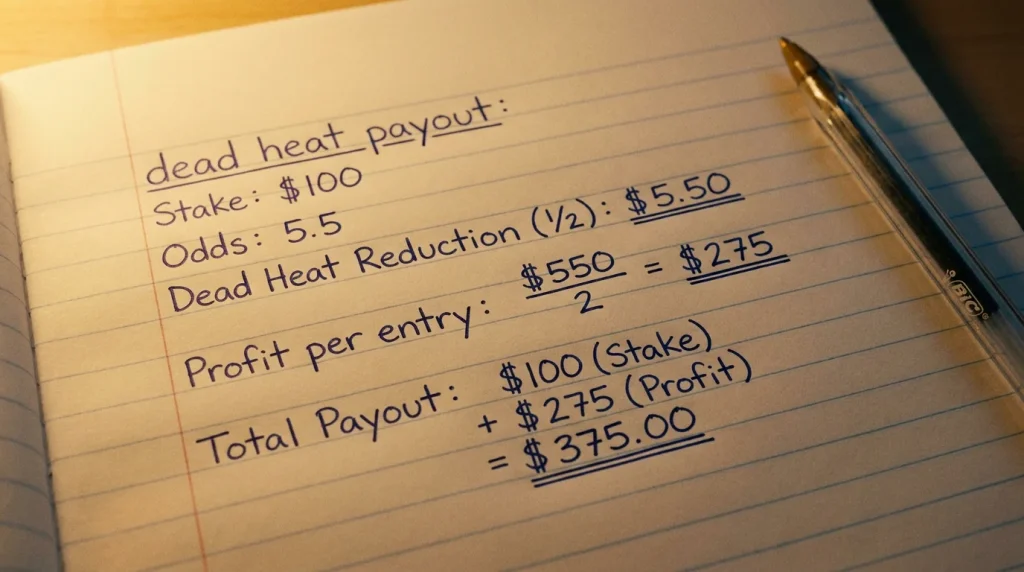
Setup: £10 each-way bet (£20 total). Odds: 30/1. Place terms: 1/4 odds, 5 places. Your player finishes in a three-way tie for 5th. The win half: your player didn’t win the tournament, so the £10 win stake loses entirely. The place half: your player is tied for 5th, and 5th is the last covered place, so the dead heat rule applies.
Step one: divide the place stake by the number of players sharing the position. £10 / 3 = £3.33 effective stake. Step two: calculate the place odds. 30/1 at 1/4 = 30/4 = 7.5/1 place odds. Step three: multiply effective stake by place odds. £3.33 x 7.5 = £25.00. Step four: add the effective stake return. £25.00 + £3.33 = £28.33 total place return. Step five: calculate net result. £28.33 minus £20.00 total outlay = £8.33 net profit.
Without the dead heat, the place return would have been £10 x 7.5 + £10 = £85.00, giving a net profit of £65.00. The three-way tie reduced your profit by 87%. That’s the bite of the dead heat rule in practice.
Mitigating Dead Heat Risk in Your Bet Selection
You can’t eliminate dead heat risk in golf — ties are structural. But you can reduce your exposure through deliberate market and selection choices.
First, favour markets with wider boundaries. A top-20 bet carries dead heat risk only when players tie for 20th specifically. A top-5 bet carries the same risk at a much tighter margin. Since ties at the 20th position involve fewer players on average than ties at 5th (the deeper into the field, the more spread the scores), top-20 bets have lower dead heat frequency and lower dead heat severity.
Second, consider the field size and scoring conditions. Events with low scoring — birdie-fests on soft courses — produce more tied positions because more players are bunched on the leaderboard. Events where conditions are tough and scoring is high tend to spread the field, reducing dead heat frequency at place thresholds.
Third, factor dead heat probability into your expected value calculations. I discount my expected payout on any place or top-finish bet by 5-10% to account for dead heat risk before comparing it to my fair price estimate. If the bet is only marginally positive expected value before the discount, it’s probably negative after, and I skip it.
Dead Heat Rules: Common Questions
How is my payout calculated when three or more golfers tie for a place?
Your stake is divided by the number of players sharing that position before the payout is calculated. In a three-way tie, your effective stake becomes one-third of the original. The odds remain unchanged — only the stake portion reduces. This means a three-way dead heat at 30/1 with 1/4 place terms pays the same rate per pound as if there were no tie, but on one-third of your original stake, resulting in a significantly lower total return.
Does a dead heat apply to each-way place bets?
Yes. Dead heats apply to the place half of an each-way bet whenever multiple players tie for the last covered place position. If your bookmaker pays five places and three golfers tie for fifth, the dead heat rule divides your place stake by three. The win half of your each-way bet is unaffected by dead heats at place positions — it only pays if the player wins the tournament outright.
Can I avoid dead heats by choosing different markets?
You cannot eliminate dead heat risk entirely in golf, but you can reduce it. Markets with wider finishing-position thresholds — top 20 rather than top 5 — have lower dead heat frequency because ties at deeper positions are less common. Tournament matchup bets and make/miss cut markets also carry lower dead heat risk than place and top-finish bets.
Articles
Created by the "Golf Betting Tips" editorial team.
