
PGA Tour Betting Tips: Field Quality, Data Depth and What Sets This Tour Apart for Punters
 Available in US

I bet on both tours every week, PGA and DP World, and the analytical experience couldn’t be more different. On a PGA Tour week, I have strokes gained data broken into four categories, proximity numbers from every distance band, putting stats by green speed and slope, and historical ShotLink data stretching back a decade. On a DP World Tour week, I’m often working with incomplete stats and filling gaps with my own manual compilation. That data asymmetry is why the PGA Tour is the backbone of my betting calendar — not because the edge is easier to find, but because the data infrastructure lets me find it with higher confidence.
The PGA Tour recorded a 20% increase in golf betting handle in 2025, and the scale of that handle tells its own story. Data from one major US sportsbook showed that 99.4% of its golf betting handle lands on PGA Tour events, with LIV Golf and other tours fighting over the remaining fraction. For UK punters, the PGA Tour isn’t just the most popular betting product — it’s the most analytically rich, and that richness is what makes it simultaneously the sharpest and the most exploitable market in golf.
PGA Tour Structure: Signature Events, Elevated Fields and the FedExCup
The PGA Tour calendar in 2026 is built around a tiered structure that directly affects betting strategy. At the top sit the eight signature events — tournaments with purses of $20 million or more, restricted fields of roughly 70 players, and mandatory appearance from the tour’s top names. Below those are the standard full-field events with 132-156 players and more diverse skill levels. The FedExCup Playoffs in August provide the season’s climax: three events with progressively smaller fields, culminating in a 30-player Tour Championship.
The structural tier matters for betting because it determines field strength, data depth, and market efficiency. Signature events attract the sharpest bookmaker pricing because the fields are star-studded and the handle is enormous. Standard events — particularly those opposite signature events, when top players are committed elsewhere — draw weaker fields and softer pricing. This is where I’ve found some of my best value: a 50/1 player in a weak-field opposite event might have a genuine 3% chance of winning, while a 50/1 player in a signature-event field has closer to 1.5%.

Why PGA Tour Data Gives Bettors a Statistical Advantage
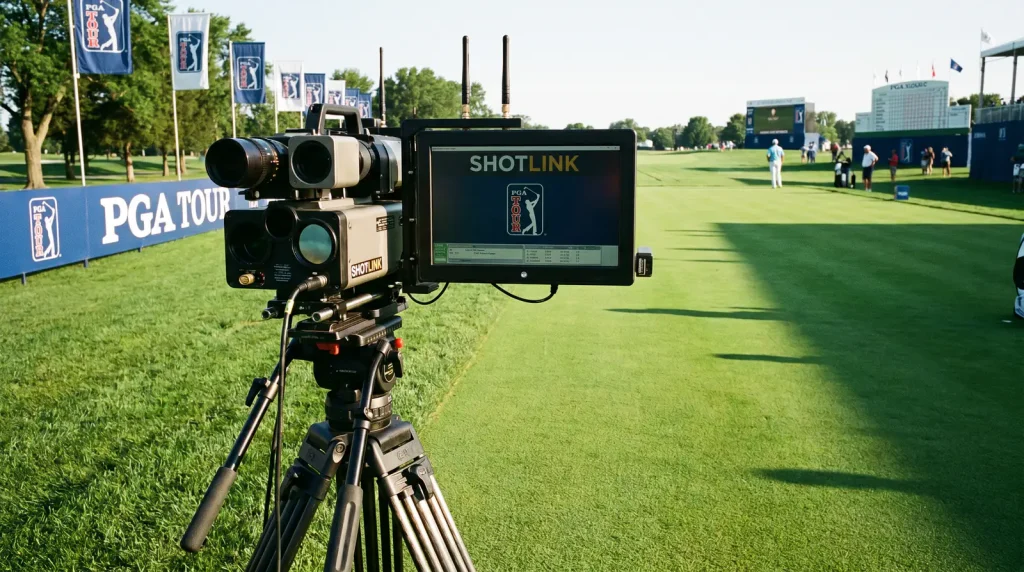
ShotLink — the laser-based tracking system installed at every PGA Tour venue — captures the position of every shot by every player in every round. That data feeds the strokes gained framework, which in turn feeds the course-fit profiles and form assessments that drive my betting process. The PGA Tour LIVE Betcast expanded from 50 hours to over 400 hours across 12 tournaments in 2026, giving in-play bettors access to shot-level information that simply doesn’t exist on any other tour.
The practical advantage for UK punters is straightforward: better data means better models, which means more accurate probability estimates, which means more precisely identified value. I can calculate a player’s SG: approach from 150-175 yards on bentgrass greens, compare it to the demands of this week’s course, and generate a probability estimate with meaningfully higher accuracy than I could using generic tour averages. That granularity is unique to the PGA Tour and is the reason my PGA Tour ROI consistently outperforms my DP World Tour ROI.
The data depth also means the market is more efficient. Bookmakers have access to the same ShotLink data I do, and their models incorporate it. The edge doesn’t come from having data the bookmaker lacks — it comes from interpreting the data differently, weighting variables in ways the algorithmic models don’t, and identifying form shifts faster than the weekly odds update captures them. For a detailed breakdown of how to translate this data into selections, my guide to strokes gained for golf betting covers the workflow step by step.
Popular PGA Tour Betting Markets Among UK Bookmakers
UK bookmakers offer a full menu of PGA Tour markets that goes well beyond outright winner. The most popular among experienced punters include each-way outrights (the core UK golf bet), top-5 and top-10 finishes, first round leader, 72-hole matchups, and round-by-round 3-ball bets. In-play coverage runs from Thursday through Sunday during featured broadcast hours, with live odds on tournament winner, top-finish, and scoring markets.
The UK sports betting market generates approximately £2.48 billion in annual gross gaming yield, and PGA Tour golf commands a disproportionate share of golf-specific handle within that figure. Each-way terms for PGA Tour outrights typically offer 1/4 or 1/5 odds for 5-8 places, depending on field size and tournament significance. During major weeks, enhanced place terms push coverage to 10 or even 12 places, creating additional value opportunities for each-way bettors.
One market worth highlighting is the 72-hole matchup. Bookmakers pair two players of similar outright odds and you pick the winner over the full tournament. I find these particularly profitable at PGA Tour events because the ShotLink data lets me compare players head-to-head with precision that isn’t possible on other tours. A matchup between two 40/1 players where one has significantly better SG: approach numbers on this course type is a bet I’ll take every time the price is right.

First round leader bets also benefit from the PGA Tour’s data advantage. Round-one scoring is influenced by tee-time draw, morning weather conditions and how a player performs in Thursday’s opening-round pressure. ShotLink’s round-by-round strokes gained breakdown lets me isolate how a player performs specifically in round one — a level of granularity that isn’t available for most DP World Tour events. Some players consistently score well on Thursdays and fade over the weekend; others start slowly and build. Identifying these patterns through data rather than narrative is only possible because ShotLink captures every shot in every round, and that specificity is what makes the PGA Tour the most analytically rewarding tour to bet on.

PGA Tour Betting: Common Questions
What is the difference between PGA Tour and DP World Tour for betting?
The main differences are data depth and field strength. The PGA Tour"s ShotLink system provides shot-level strokes gained data for every player at every event, enabling granular statistical analysis. The DP World Tour has less comprehensive data coverage. PGA Tour fields are generally stronger at signature events, while DP World Tour events often feature larger fields with greater variance — creating potential value for bettors willing to do the extra research.
When do PGA Tour betting markets open each week?
Most UK bookmakers post outright and top-finish markets for PGA Tour events by Monday of tournament week, sometimes Sunday evening. Matchup and first round leader markets typically appear on Tuesday or Wednesday. In-play markets open when the first group tees off on Thursday. Ante-post markets for major championships and FedExCup futures can be available months in advance.
Are PGA Tour fields stronger than DP World Tour fields?
At signature events, yes — PGA Tour fields feature mandatory appearances from the world"s top 50+ players. At standard non-signature events, field strength varies considerably. Opposite-field PGA Tour events — those running the same week as a signature event — can feature fields comparable to mid-tier DP World Tour events. Always assess field strength on an event-by-event basis rather than assuming one tour is universally stronger.
Articles
Written by the editors at Golf Betting Tips.
