
Golf Accumulator Tips: When Multi-Bet Cards Work and When They Burn Your Bankroll
 Available in US

I’ll be honest: I have a complicated relationship with golf accumulators. The rational part of my brain knows the maths are hostile. The emotional part remembers a four-fold top-10 accumulator in 2022 that returned £2,400 from a £15 stake and funded my entire autumn betting bankroll. That tension — between the mathematical reality and the occasional spectacular payoff — is exactly why accumulators deserve a clear-eyed breakdown rather than either blind enthusiasm or blanket dismissal.
The PGA Tour saw a 20% jump in betting handle in 2025, and accumulator volume has grown even faster than singles. Bookmakers love accumulators because the combined margin across multiple legs compounds in their favour. But that same compounding dynamic, understood properly, gives you a framework for deciding when an accumulator makes tactical sense and when it’s just an expensive lottery ticket.
How Golf Accumulators Compound Odds and Risk
An accumulator — acca for short — chains two or more selections into a single bet where every leg must win for the bet to pay out. The appeal is obvious: the odds multiply. A three-fold combining selections at 2/1, 3/1 and 5/2 produces combined odds of roughly 52/1, turning a £5 stake into a £265 return. The problem is equally obvious: if any single leg loses, the entire bet is dead.
In outright golf markets, where even a strong favourite has a win probability around 8-10%, a four-fold accumulator on outright winners has an expected hit rate that’s measured in fractions of a percent. Let me make that concrete. If you combine four players each with a genuine 8% win probability — roughly the best player in a signature-event field — the probability of all four winning is 0.08 x 0.08 x 0.08 x 0.08 = 0.000041, or about 1 in 24,000. The bookmaker’s compounded margin makes the actual payout significantly worse than those raw odds suggest. That’s not a bet; it’s a donation.
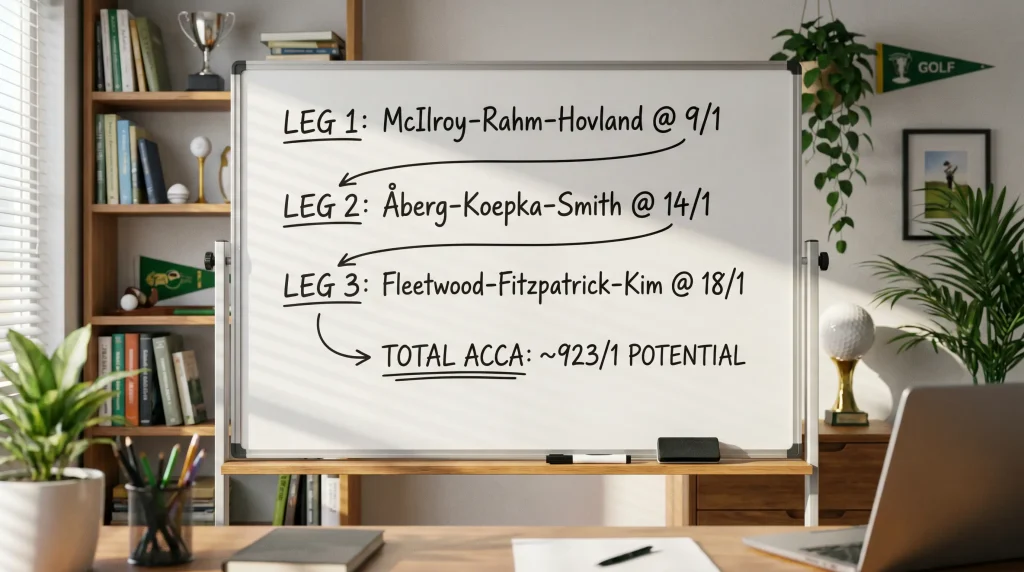
The margin compounding is the critical piece most punters miss. Each individual leg carries a bookmaker overround of perhaps 5-10%. Across four legs, those margins multiply — a 7% margin per leg becomes an effective overround of roughly 31% across a four-fold. You’re fighting a house edge that would embarrass a roulette wheel. Pamela Maldonado, whose work on golf betting analytics I follow closely, put it well: “Golf betting is a slow-burn panic, like a 3-footer that suddenly feels twice as long. The sharper approach is building a card with intention and direction.” Accumulators built without intention are the fastest route to that panic.
Building a Golf Accumulator: Market Selection and Leg Limits
If you’re going to build golf accumulators — and I do, selectively — the construction matters far more than the picks. My rules are strict. Maximum three legs, never four or more. No outright winner legs in any accumulator, period. And every leg must come from a market where the expected strike rate exceeds 25%, which means top-10 finishes, top-20 finishes, make-the-cut bets, or 72-hole head-to-head matchups.
The reasoning is mathematical. A three-fold where each leg has a 30% strike rate hits approximately 2.7% of the time. That’s still low, but it’s within the realm of reasonable expectation over a season of 48 tournaments. If you place one such accumulator per week, you’d expect to hit roughly once every 37 weeks — painful, but survivable with proper staking. Increase the leg count to four and the hit rate drops to 0.8%, meaning you’d wait over two years on average between winners. The entertainment value isn’t worth the bankroll erosion.

I also keep accumulator stakes tiny — never more than 0.5% of my bankroll, compared to the 1-2% I’ll put on a value single. The accumulator is a bonus play sitting on top of a disciplined singles portfolio, not a replacement for it. If your accumulator allocation is larger than your singles allocation, the structure is inverted and the maths will eventually punish you.
Using Top-Finish Markets to Improve Strike Rate
This is where accumulators start making tactical sense. A top-5 finish bet on a player priced at 7/2 carries an implied probability of about 22%. A top-10 at 6/4 implies roughly 40%. A top-20 at 4/6 implies about 60%. By selecting accumulator legs exclusively from these higher-probability markets, you dramatically improve your hit rate while still achieving meaningful combined odds.
A three-fold combining three top-10 picks at 6/4, 2/1 and 7/4 produces combined odds around 20/1. A £5 stake returns £105. The hit rate? If each leg genuinely has a 35% chance, the combined probability is 4.3% — roughly once every 23 attempts. That’s a bet I can live with, especially because the selections themselves overlap with my standard top-finish analysis. I’m not doing extra work to find accumulator legs; I’m chaining my best top-finish value plays together for an occasional bonus payout.

Why Most Golf Accas Lose and How to Tilt the Maths
Walk into any betting shop on a Thursday morning during a PGA Tour event and you’ll see the same thing: punters building five-fold and six-fold accumulators on outright winners at triple-digit prices. These bets look thrilling on paper. The combined odds might be 10,000/1 or more. The probability of them landing is effectively zero. The bookmaker’s margin across that many legs at those odds is astronomical — often exceeding 60%.

The tilt in your favour comes from three adjustments. First, fewer legs — three maximum, as I’ve described. Second, higher-probability markets where your analytical edge has more room to operate. Third, correlated selections. If you’re backing three players to finish top 10 at the same event, and those players share a common strength that the course demands — say, elite approach play at a layout where greens in regulation correlates strongly with top-10 finishes — there’s a positive correlation between the legs that the bookmaker’s model may not fully capture. Those correlated accumulators outperform random combinations over time because the shared edge amplifies across legs rather than just multiplying.
The honest summary is this: accumulators should never form the core of a golf betting strategy. They’re a supplementary play, capped at small stakes, limited to three legs, and built exclusively from markets where you already hold a positive expected value on each individual selection. Anything beyond those parameters is entertainment spending, not strategic betting — and you should label it as such in your tracking spreadsheet.
Golf Accumulator Betting: Common Questions
What is the maximum number of legs for a golf accumulator?
Most UK bookmakers allow up to 10 or more legs in a golf accumulator, but from a strategic perspective, three legs is the practical maximum. Beyond three, the compounding bookmaker margin and the collapsing hit rate make the bet virtually unwinnable over time. Stick to three legs using higher-probability markets like top-10 or top-20 finishes.
Are each-way accumulators available for golf?
Yes, most UK bookmakers offer each-way accumulators on golf. Each leg is treated as two separate bets — win and place — and the accumulator runs through both halves independently. If all win halves land, the payout is substantial. If some legs place but don"t win, the place accumulator can still return a profit, though typically a modest one. Each-way accas add cost because you"re effectively doubling your stake per leg.
How do withdrawals affect a golf accumulator?
If a golfer in your accumulator withdraws before the tournament starts, that leg is typically voided and the accumulator recalculates at reduced odds — a four-fold becomes a treble, for example. If the golfer withdraws during the tournament, rules vary by bookmaker. Some settle the leg as a loser; others void it. Always check withdrawal terms before placing an accumulator, particularly for events with published injury concerns.
Articles
Written by the editors at Golf Betting Tips.
