
Responsible Gambling for UK Golf Bettors: Regulation, Self-Assessment and Support Tools
 Available in US

Three seasons ago, I noticed something in my own behaviour that stopped me mid-week. I’d placed a full card on Tuesday for that week’s PGA Tour event, lost every selection by Friday evening, and found myself at 11pm scanning DP World Tour markets for Saturday just to “get back to even.” I hadn’t opened a spreadsheet, hadn’t checked a single strokes gained profile, hadn’t run any of the process I’d spent two years building. I was chasing. The problem gambling rate among UK adults sits at 2.7% as measured by the PGSI, but that number obscures a more troubling figure: among online sports bettors specifically, that rate jumps to 7.2%. Roughly one in fourteen people betting on sport online in the UK meets the clinical threshold for problem gambling. Golf betting — with its weekly cadence, long odds and season-length timelines — carries structural features that make escalation gradual and hard to spot.
This article isn’t a lecture. I’m writing it because I’ve had to use the tools described below myself, and they worked. Understanding the regulatory framework that protects UK bettors isn’t just compliance reading — it’s practical self-defence.
UK Regulation in 2026: What Bettors Need to Know
I spent years paying no attention to regulation. It felt like someone else’s problem — a concern for operators and their compliance departments, not for the person placing bets. That changed when a promotional offer I’d been relying on for golf accumulators disappeared overnight. Since December 2025, operators have been required to restrict potentially harmful promotions that encourage cross-product betting — a rule that directly reshaped how golf-specific offers are structured and marketed. Suddenly, regulation wasn’t abstract. It had cost me a tangible edge in my weekly card.
Every UK-facing bookmaker must hold a Gambling Commission licence. That requirement sounds bureaucratic, but it means every operator you use is subject to the Licence Conditions and Codes of Practice — a set of enforceable rules covering everything from how odds are displayed to how quickly withdrawal requests must be processed. The Gambling Commission, in its 2026-2027 Business Plan, stated that the licensed market in Great Britain is regarded as one of the most robust globally, built on an unwavering focus on making gambling safer, fairer and free from crime. That statement isn’t marketing. It’s a regulatory body explaining why every tool discussed in this article exists and why operators face penalties for failing to provide them.
UK gross gaming yield reached £4.5 billion in Q4 2025 alone. A market that size attracts regulatory attention proportional to its scale. For you as a bettor, the practical implication is that every platform you use must offer specific self-management tools by law. These aren’t optional extras or features that a progressive operator chose to add for good press. They’re mandatory. If an operator isn’t providing deposit limits, session reminders and self-exclusion options, they’re breaking the law — and you should close your account immediately.

Problem Gambling Indicators: The PGSI Self-Check
A conversation I had with a friend last autumn made this section necessary. He’d been betting on golf for about eighteen months — mostly outrights, some matchups, the occasional accumulator. His results were roughly break-even. He told me he was “completely fine” with his betting. Then I asked him three specific questions from the PGSI. Had he bet more than he could afford to lose? Had he gone back to try to win back money he’d lost? Had anyone criticised his betting or told him he had a problem? He answered yes to all three. That’s a score of at least 3 on a scale where 8 or above indicates problem gambling, and 3-7 indicates moderate risk.

The PGSI — Problem Gambling Severity Index — is a 9-question screener developed for population research but freely available online for self-assessment. It takes two minutes. Each question asks about behaviour over the past twelve months, scored from 0 (never) to 3 (almost always). The resulting score places you in one of four categories: non-problem (0), low risk (1-2), moderate risk (3-7) or problem gambler (8+). What makes the tool genuinely useful for golf bettors specifically is that several questions map directly onto patterns that the sport’s structure encourages.
Question four asks whether you’ve borrowed money or sold anything to get money to gamble. That might sound extreme, but consider a more subtle version: dipping into next month’s betting allocation because this week’s tournament field looks exceptionally strong. That’s using money earmarked for future bets to fund current ones — a structural cousin of borrowing that the PGSI would flag. Question seven asks about feeling guilty after gambling. In golf betting, guilt often manifests not after a single loss but after a sequence: you miss three weeks in a row, override your staking rules for week four, lose that too, and the cumulative weight of deviation from your own process creates a specific kind of regret. If any of this sounds familiar, the PGSI is worth two minutes of your time.
Self-Control Tools: Deposit Limits, Time-Outs and GamStop
When I caught myself chasing that Friday evening three seasons ago, I didn’t rely on willpower. Willpower is a depletable resource, and by Friday of a losing week it’s already spent. I used deposit limits instead. Every UK-licensed bookmaker must offer daily, weekly and monthly deposit limits — hard caps that you set yourself and that the operator cannot override without a mandatory cooling-off period before any increase takes effect.
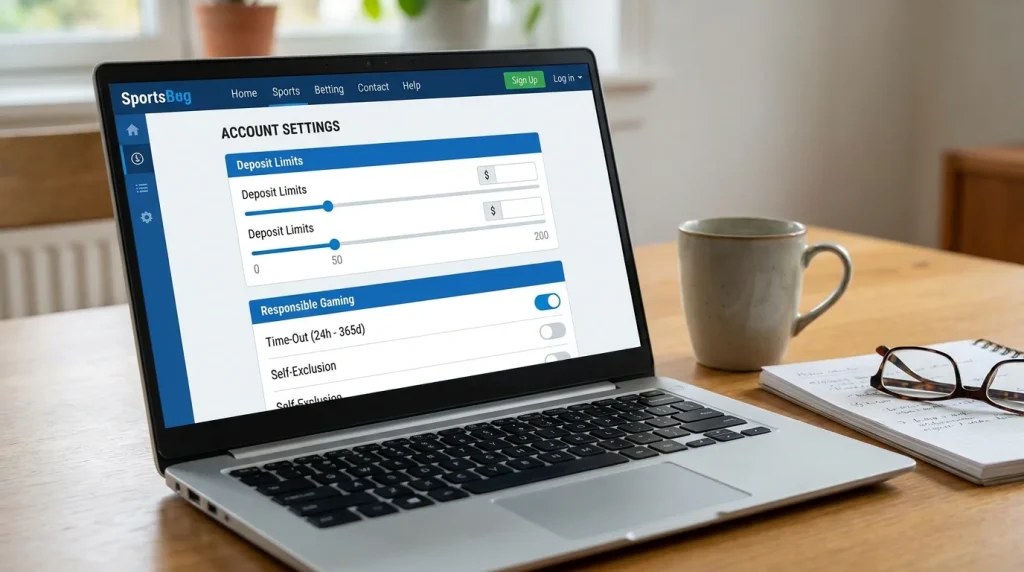
I set my weekly deposit limit to match exactly one week’s allocation from my bankroll management plan. That mechanical barrier did what discipline couldn’t: it made chasing physically impossible. The money simply wasn’t available. Session time reminders — alerts that tell you how long you’ve been logged in — are the second layer. I set mine to 60 minutes. Not because I think an hour is some magical threshold, but because the alert forces a break in the action, a moment where I have to consciously decide to continue rather than drifting on autopilot.

Cooling-off periods escalate the intervention. You can pause your account for 24 hours, 48 hours, 7 days or up to 6 weeks depending on the operator. During a cooling-off period, you can’t log in, can’t deposit and can’t place bets. For golf bettors dealing with a bad run of form, a one-week cooling-off that spans a single tournament is often enough to break the emotional cycle without disrupting a season-long strategy.
GamStop is the most comprehensive tool available. It’s a free multi-operator self-exclusion scheme: a single registration blocks you from all UK-licensed online gambling operators for 6 months, 1 year or 5 years. Registration is straightforward and takes a few minutes. The minimum exclusion period is six months, and once activated it cannot be reversed early. GamStop is not a last resort — it’s a precision instrument. If your tracking data shows that your process breaks down repeatedly during a specific period (for me, the autumn swing when PGA Tour and DPWT schedules overlap and I was placing too many bets per week), a targeted six-month exclusion can protect a year’s worth of results.
The National Gambling Helpline — 0808 8020 133 — offers free, confidential support. It exists because some patterns need a conversation, not a spreadsheet adjustment.
Responsible Gambling: Common Questions
What tools can I use to control my golf betting spending in the UK?
Every UK-licensed bookmaker must offer deposit limits (daily, weekly, monthly), session time reminders, cooling-off periods from 24 hours to 6 weeks, and self-exclusion for a minimum of 6 months. GamStop provides multi-operator self-exclusion with a single registration covering all UK-licensed online gambling sites. These are legal requirements, not optional features.
How does GamStop self-exclusion work for golf bettors?
GamStop is a free service. You register once with your personal details and choose an exclusion period of 6 months, 1 year or 5 years. Once active, you are blocked from logging in, depositing or placing bets with any UK-licensed online gambling operator. The exclusion cannot be reversed early. For golf bettors, a 6-month exclusion during a period of poor process discipline can protect an entire season of bankroll management.
Where can I get help if golf betting becomes a problem?
The National Gambling Helpline (0808 8020 133) offers free, confidential support. The PGSI self-assessment is a 9-question screener available free online that takes two minutes and can reveal risk patterns. GamCare provides online chat and forum support. Your GP can also refer you to NHS gambling addiction services. Reaching out is not a sign of weakness — it is a practical step that experienced bettors take when their own tools are not enough.
Articles
Prepared by the Golf Betting Tips editorial staff.
