
Each-Way Golf Betting: How Place Terms, Field Size and Payouts Shape Your Returns
 Available in US

I placed my first each-way golf bet in 2019 — a tenner on a 66/1 shot at the Scottish Open. He finished ninth. The win half died on the vine, but the place half paid out at a quarter of the odds, and I walked away with more than my stake back. That small return did something no outright winner ever could: it taught me that golf betting is not just about picking champions. It is about understanding the mechanics behind the payout.
Each-way betting is the backbone of golf punting in the UK. The PGA Tour recorded a 20% increase in golf betting handle in 2025 — the fourth consecutive year of double-digit growth — and a significant chunk of that action, particularly on this side of the Atlantic, flows through each-way slips. The format suits golf better than almost any other sport because fields are large, variance is enormous, and a player finishing sixth can still put money in your pocket.
This guide breaks down every moving part of an each-way golf bet: how the split works, how payouts are calculated, how field size alters your terms, and where enhanced place offers genuinely add value rather than just dressing up a poor price. If you have ever stared at a betting slip wondering whether E/W is worth the extra outlay, the next few thousand words should settle the question.
How an Each-Way Bet Splits into Win and Place
A couple of years ago, a friend texted me mid-tournament asking why his “each-way bet” showed two separate lines on his account. He thought the bookmaker had duplicated the wager. That confusion is more common than you would expect, so let me clear it up from the start.
An each-way bet is two bets in one. When you place a GBP10 each-way wager, you are spending GBP20 — GBP10 on the win and GBP10 on the place. The win half pays out only if your golfer finishes first. The place half pays out if your golfer finishes inside a set number of positions, usually the top five or top six in a full-field event, at a fraction of the outright odds.
That fraction is determined by the bookmaker’s place terms — typically 1/4 or 1/5 of the win odds. So if you back a player at 40/1 each-way with 1/5 place terms and he finishes fourth, your win bet loses, but your place bet pays at 40/1 divided by five, which is 8/1. On a GBP10 place stake, that returns GBP80 profit plus your GBP10 stake back. Subtract the GBP10 you lost on the win half, and you are still GBP80 up from a GBP20 total outlay.
The key insight here is that the two halves of the bet live independent lives. The win half is a straightforward outright punt. The place half is closer to a top-five or top-six finishing position bet, but priced off the outright odds rather than an independent market. That link to the outright price is what creates the value — or destroys it — depending on the situation.
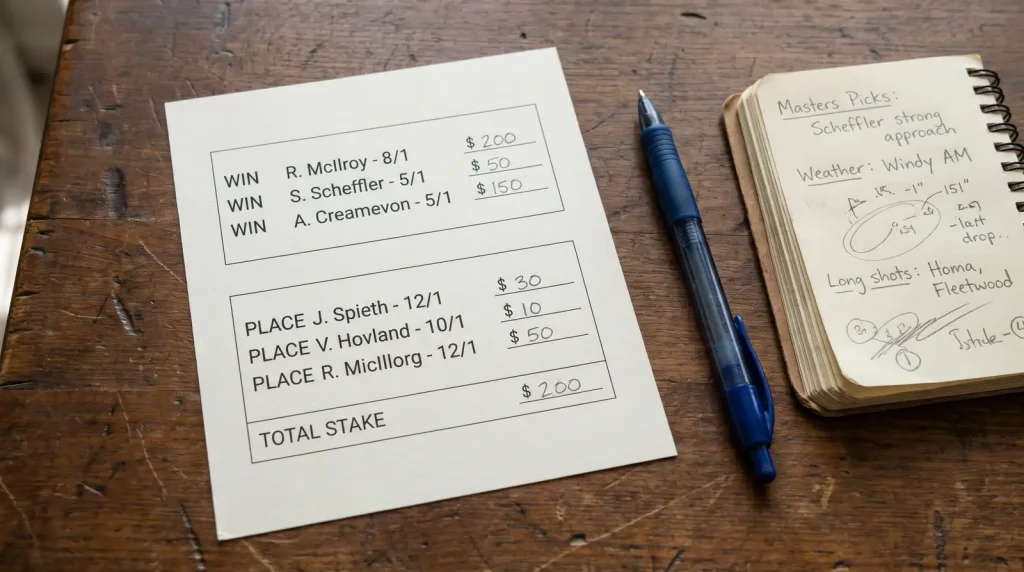
Three variables control the size of your each-way return: the outright odds, the place fraction, and the number of qualifying places. Change any one of those and the entire risk-reward profile shifts. A 25/1 shot with 1/4 odds for five places is a completely different proposition from a 25/1 shot with 1/5 odds for eight places, even though the headline price looks identical. Learning to see past the outright number is the first step toward using each-way betting as a genuine strategic tool rather than a hopeful add-on.
One more detail that trips people up: each-way is not the same as “place only.” Some bookmakers offer standalone place bets with independently priced odds that do not reference the outright market. Those are a separate product entirely. Each-way always derives the place price from the win price — that mechanical link is what defines the bet.
Standard Place Terms Across UK Bookmakers
Place terms are not universal. Different bookmakers offer different fractions and different numbers of places, and those differences compound over a season of betting. Here is what you will typically see for a standard 72-hole stroke-play event with a full field of 156 players.
The industry standard for golf is 1/5 of the odds for five places. That means positions one through five qualify for a place payout, and the place odds are calculated by dividing the win odds by five. Some operators push this to six places at 1/5 during majors or high-profile events, which is meaningful — adding a sixth qualifying position in a 156-player field might sound marginal, but the difference in strike rate is noticeable over a full season.
A handful of firms offer 1/4 of the odds instead. At first glance, 1/4 looks more generous than 1/5, and in isolation it is — the place payout per qualifying finish is higher. But operators offering 1/4 typically reduce the number of places to four. So you get a bigger payout per place hit but hit it less often. Whether that trade-off works in your favour depends on the type of selections you make. If you lean toward longer-priced players who might sneak into the top six but rarely crack the top four, 1/5 for five places serves you better. If your picks tend to be mid-range prices with top-four potential, 1/4 for four places can deliver more over time.
The terms can also change mid-week. Some bookmakers enhance their standard terms as a promotional tool — shifting from five places to seven or eight, or from 1/5 to 1/4, specifically for a particular tournament. I always check the terms on the slip before confirming, not just the day I first looked at the market. Terms that were five places on Monday might be seven places by Wednesday afternoon.
One practical habit I have built over the years: I keep a simple spreadsheet logging the standard golf place terms for the four or five bookmakers I use most. Across a 48-week season, those small differences in fraction and place count add up. The punter who blindly takes whatever terms are offered is leaving value on the table week after week.

Calculating Each-Way Payouts Step by Step
I once sat in a pub watching the final round of the Open Championship and listened to two punters argue about what their each-way bet would pay if their player held on for third. Neither had any idea how to calculate it. By the time they figured it out on a napkin, the player had bogeyed 17 and the argument was academic. Do not be those two. The maths here is straightforward once you walk through it.
Take a concrete example. You back a player at 50/1 each-way with standard terms of 1/5 odds for five places. Your stake is GBP5 each-way, so GBP10 total. If the player wins, your win half pays 50/1 on GBP5 (GBP250 profit plus GBP5 stake returned = GBP255) and your place half also pays because first is a qualifying position — that is 50 divided by 5 = 10/1 on GBP5 (GBP50 profit plus GBP5 stake = GBP55). Total return: GBP310 from a GBP10 outlay.
Now suppose the same player finishes fourth. The win half loses — you are down GBP5. The place half pays at 10/1 on GBP5 = GBP50 profit plus your GBP5 stake returned. Net result: GBP50 profit on a GBP10 total bet. That is a 500% return on investment from a player who did not win the tournament.
The UK sports betting market generates around GBP2.48 billion in annual gross gaming yield — one of the largest regulated markets in the world — and each-way golf bets contribute a disproportionate share of that handle relative to the sport’s overall viewership. The reason is simple: those place-half payouts keep punters engaged even when the win half is dead, and that engagement drives repeat betting across the full season.
Here is where it gets interesting. Change the place fraction from 1/5 to 1/4 and keep everything else the same. The place payout becomes 50 divided by 4 = 12.5/1 on GBP5 = GBP62.50 profit plus GBP5 stake. Net result: GBP57.50 from GBP10 — a 575% ROI. That extra 1.5 points of payout difference does not sound dramatic on a single bet, but apply it across 30 or 40 wagers over a season and the cumulative effect is real.
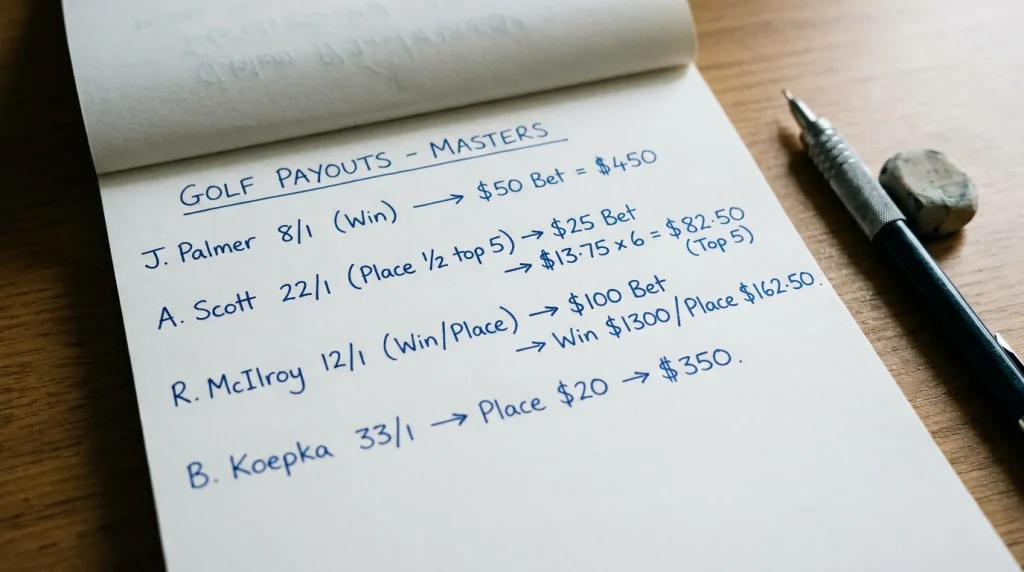
Always run the calculation before you place the bet, not after. I know that sounds obvious, but the number of punters who look at “50/1 each-way” and think of it as a GBP5 bet is remarkably high. It is a GBP10 bet, and the expected return depends entirely on the probability of a place finish — not a win — which is a very different number.
How Field Size Changes Place Fractions
Field size is the hidden variable that most each-way punters ignore. A standard PGA Tour event starts with 144 to 156 players. The Open Championship fields 156. But some events — particularly invitational tournaments and late-season playoffs — run fields of 70, 50, or even 30 players. And the each-way terms shift accordingly.
For fields of 16 or more players, you will generally see the standard five-place terms. Drop below 16 and many bookmakers reduce to three places or even two. Some withdraw each-way entirely for very small fields. The FedEx Cup finale, for instance, features only 30 players, and the each-way terms there are visibly tighter than at a regular full-field event. The place fraction might stay at 1/5, but you are now looking at three or four qualifying positions in a 30-player field rather than five in 156.
Why does this matter? Because the ratio of qualifying places to total field is what drives your expected place-hit rate. Five places from 156 runners means roughly 3.2% of the field qualifies. Three places from 30 runners means 10%. That sounds like the smaller field is better for each-way, but the odds are dramatically shorter in small fields — a 66/1 shot in a full-field event might be 14/1 in a 30-player field, and the place payout collapses proportionally. The larger field with longer prices and more places frequently offers the superior each-way proposition, even though the absolute probability of placing is lower.
I have a rule of thumb that has served me well: each-way betting works best in fields of 120 players or more, where the outright odds on mid-tier players run between 40/1 and 100/1, and the place terms extend to at least five positions. Below that threshold, I look at other markets — top-10 or top-20 finish bets, matchups, or straight win wagers — because the each-way maths tightens in ways that are hard to overcome without exceptional selection accuracy.
Enhanced and Extra Place Offers: When They Add Value
Every Thursday morning during a major, my inbox fills with promotional emails: “8 places each-way on the Masters!” “Enhanced terms — 1/4 odds for 7 places!” These offers are the most visible marketing tool in golf betting, and they range from genuinely valuable to borderline irrelevant. The trick is knowing which is which.
An enhanced place offer works by increasing the number of qualifying positions beyond the bookmaker’s standard terms. If the standard is five places at 1/5, an enhanced offer might push to seven or eight places at the same fraction. That additional two or three positions can meaningfully change the expected value of an each-way bet on a longer-priced player, because the probability of finishing seventh or eighth is materially higher than the probability of finishing fifth or better.
The UK’s gross gaming yield hit GBP4.5 billion in Q4 2025, and bookmakers fund their enhanced-place promotions from that revenue pool. They are not giving money away — these offers are calibrated to attract volume while still maintaining margin. But that does not mean they lack value for the punter. It means the value is selective. An enhanced offer on an 80/1 player in a 156-player field, where the extra places push qualifying from five positions to eight, can shift the expected return on the place half from negative to positive. The same offer on a 12/1 favourite does almost nothing, because a 12/1 shot rarely finishes exactly sixth, seventh, or eighth — they either contend or fall well short.
My approach is to compare the enhanced terms against the standard terms using a simple question: what is the probability that my selection finishes in the additional positions but not in the original ones? If I back a player at 66/1 and the standard terms pay five places, the enhancement to eight places matters only if I believe there is a reasonable chance of a sixth, seventh, or eighth place finish. For mid-pack players with consistent cut-making records but limited win equity, that probability is significant. For volatile boom-or-bust types, it barely moves the needle.
Extra-place offers during majors deserve particular attention because major fields include qualifiers, amateurs, and past champions who inflate the field but rarely contend for place positions. The effective field — the number of players with a realistic chance of finishing in the top eight — is smaller than the raw number suggests. Eight enhanced places in a field where only 100 players are genuine contenders is proportionally more generous than five places in a competitive 144-player signature event.

One caveat: do not let the promotion dictate the selection. I have watched punters back players they would never normally touch simply because the enhanced terms looked appealing. The promotion adds a few percentage points of expected value to a wager that already makes sense. It does not transform a bad bet into a good one.
Each-Way Strategy by Field Volatility
Pamela Maldonado, the ESPN betting analyst, once described golf betting as “a slow-burn panic, like a 3-footer that suddenly feels twice as long” — and she was talking about outrights. Each-way betting adds a second layer to that tension, because even when the win half is buried on Saturday night, the place half might still be alive heading into Sunday’s back nine. How you handle that volatility — not just emotionally, but structurally — determines whether each-way becomes a profit centre or a slow drain.
Field volatility refers to how unpredictable the finishing order is likely to be. Some weeks, the cream rises: strong fields on well-known courses with calm conditions produce top-heavy leaderboards where the top five are all inside the world’s top 30. Other weeks — particularly at exposed links courses or lesser-known venues on the DP World Tour — the leaderboard splinters. Unheralded players post low rounds, established names miss cuts, and the top-five finishing positions include two or three names priced at 80/1 or longer. For a deeper look at how tournament quality shifts the maths, I have written separately about field strength analysis and its impact on your card.
In high-volatility weeks, each-way betting thrives. The place-hit rate for long-priced players rises, and the place payout — calculated as a fraction of those generous outright odds — delivers strong returns. A 100/1 shot placing fifth at 1/5 odds pays 20/1 on the place half. In a volatile field, a player priced at 100/1 has a meaningfully higher chance of cracking the top five than in a controlled, top-heavy environment.

In low-volatility weeks, the opposite happens. Favourites dominate, the top five finishers are all short-priced, and the place-half payouts on longer shots rarely materialise. These are the weeks where each-way bets on 66/1 selections feel like throwing money into a shredder. The maths has not changed — the place fraction is the same, the number of qualifying positions is the same — but the probability of your pick occupying one of those positions has dropped sharply.
I adjust my each-way exposure week by week based on two signals: the field-strength rating and the venue profile. When both point toward volatility — a mid-tier field at an unpredictable course — I lean heavily into each-way, sometimes placing three or four E/W bets on longer-priced picks. When the field is stacked and the course favours ball-strikers with proven records, I pull back on each-way and redirect the stake toward matchup bets or top-10 markets where the value sits in a different place.
This is not a fixed formula. It is a principle: each-way betting rewards you most when the finishing order is hard to predict. The sharper you get at identifying those weeks, the more your each-way returns improve across a full calendar.
When Each-Way Outperforms a Straight Win Bet
The question I get asked most about each-way is: “When should I just back the win instead?” The honest answer is that a straight win bet is the right call less often than most people think, at least in golf.
Each-way outperforms a straight win bet when the odds are long enough that the place-half payout justifies the doubled stake. As a rough guide, that crossover point sits around 20/1. Below 20/1, the place fraction generates payouts that barely cover the extra outlay — backing a 10/1 shot each-way at 1/5 means the place half pays 2/1, and you need a top-five finish just to break even on the total bet. Above 20/1, the place-half returns start to deliver genuine profit even when the win half dies.
The estimated US golf betting market reached $3.5 billion in 2023, and the UK market mirrors the trend toward higher volumes at longer prices. The growth is partly structural: sportsbooks have expanded the number of place positions available on golf, which in turn makes each-way more attractive to recreational punters who want extended engagement without the binary win-or-lose outcome of an outright.
There is also a profile angle. Each-way suits players who are consistent finishers rather than one-week wonders. A golfer who has placed inside the top 10 in six of his last eight starts is a far better each-way proposition at 50/1 than a volatile talent who either wins or misses the cut. The place half needs a realistic chance of landing to do its job, and that chance comes from consistent ball-striking and reliable weekend rounds, not from spectacular but erratic form.
I back the win only when three conditions align: the player is priced under 20/1, I believe the price significantly underestimates his actual win probability, and the field is small enough that the each-way terms are unattractive. Outside that narrow scenario, each-way is my default for golf outright markets. The doubled stake is a cost, but the insurance of the place half has saved my season-long P&L more times than any single outright winner.
Common Each-Way Errors and How to Avoid Them
I have made every each-way mistake on this list at least once. Some of them I made for years before the penny dropped. Here are the errors that cost real money and how to avoid them.
The first and most expensive mistake is ignoring the total outlay. Punters think in terms of “a fiver each-way” as though that is a GBP5 bet. It is a GBP10 bet. If you place four each-way bets at GBP5 per tournament, your weekly exposure is GBP40, not GBP20. Over a 40-week season, that is GBP1,600 staked. Track the total, not the unit, or your bankroll will erode faster than you expect.
The second mistake is backing each-way at short prices. A 12/1 shot each-way with 1/5 terms pays 12/5 (2.4/1) on the place half. To generate positive expected value at that payout, your player needs to finish in the top five roughly 30% of the time. Almost no golfer in the world achieves a 30% top-five rate across a full season against full-strength fields. The numbers simply do not support each-way betting at single-figure odds for most events.
Third: treating all bookmakers’ terms as identical. I mentioned this in the place-terms section, but it bears repeating as an error rather than a concept. Failing to compare terms across three or four operators before placing the bet is the easiest value to recover. It costs nothing but five minutes of checking.
Fourth: overloading on each-way in a single tournament. I have seen punters back five or six players each-way in the same event, thinking they are “covering the field.” In reality, they are building a portfolio with enormous overlap and compounding the dead-money problem. If all six players miss the top five, you lose twelve units instead of two. I rarely place more than three each-way bets on the same event, and usually it is two — one mid-price selection and one longer shot.
Fifth: not accounting for dead heats. When three players tie for fourth in a five-place each-way market, the dead heat rule divides your stake proportionally. Instead of a full payout, you receive a fraction. Dead heats in golf are common because stroke-play scoring naturally bunches players at the same total. If your each-way strategy depends on narrow place finishes at the edge of the qualifying positions, dead heats will shave your returns more than you anticipate.
Each of these errors is fixable, and none requires sophisticated modelling. They require attention. Each-way betting rewards discipline as much as selection skill — possibly more.

Each-Way Golf Betting: Frequently Asked Questions
Do all UK bookmakers offer the same each-way place terms for golf?
No. Standard terms vary between operators. Most offer 1/5 odds for five places on full-field events, but some use 1/4 odds for four places. During majors and high-profile tournaments, several bookmakers enhance their terms to six, seven, or eight places. Always compare terms across at least three operators before placing your each-way bet.
Is each-way betting better for long-shot golfers or favourites?
Each-way works best with longer-priced selections, typically 20/1 and above. At those odds, the place-half payout is large enough to generate meaningful returns even without a win. Below 20/1, the place fraction produces payouts that barely justify the doubled stake.
How does a dead heat affect each-way payouts?
When two or more players tie for a qualifying place position, the dead heat rule divides your stake proportionally among the tied players. If three players tie for fifth in a five-place market, only one of those positions counts, and your stake is divided by three. The payout is calculated on that reduced stake rather than the full amount.
Can I place an each-way accumulator on golf?
Yes, most UK bookmakers accept each-way accumulators on golf. Both the win and place halves are treated as separate accumulators — the win legs multiply together and the place legs multiply together. The combined odds can be attractive, but the strike rate drops sharply with each additional leg, making each-way accas a high-risk proposition best used sparingly.
Your Each-Way Edge Starts with the Maths
Each-way golf betting is not a gamble dressed up as strategy. It is a structured approach to a sport where finishing inside the top five from a field of 156 is a genuine achievement worth backing. The place terms, the fraction, the field size, the volatility of the event — all of these variables are knowable before you place the bet. The punters who treat each-way as an afterthought lose to the punters who treat it as a calculation.
Run the numbers on every each-way wager. Compare the terms. Match the bet to the week. Do that consistently, and the place half will carry more seasons than the win half ever will.
Articles
Created by the "Golf Betting Tips" editorial team.
