
LIV Golf Betting: What UK Punters Need to Know About the 54-Hole Team Format
 Available in US

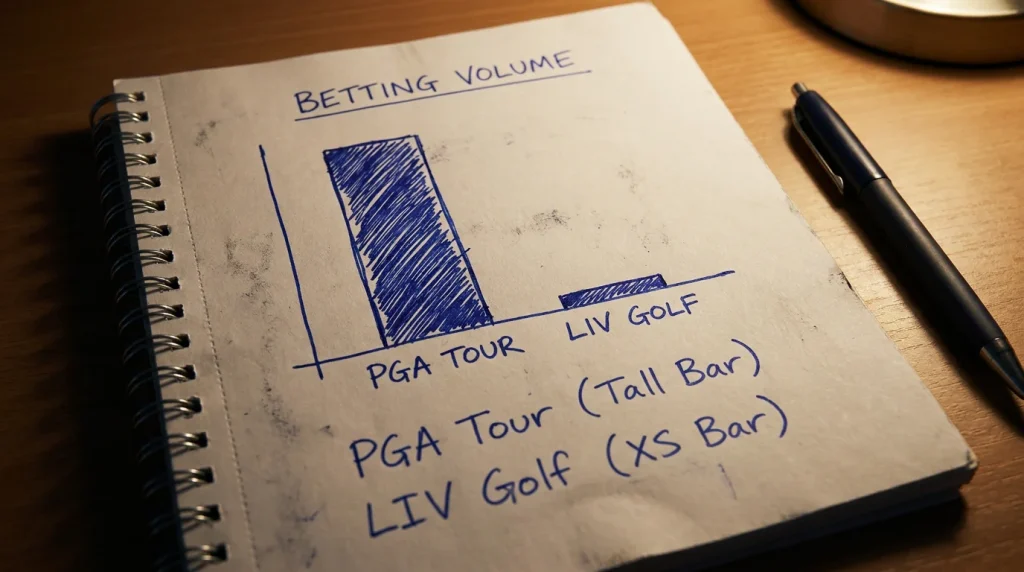
The first time I tried to bet on a LIV Golf event, I treated it exactly like a PGA Tour tournament. I pulled up strokes gained profiles, filtered by recent form, checked course history and built a shortlist of five players. Two hours of work, methodical and familiar. Then I looked at the market. Three days, not four. No cut. Shotgun starts instead of traditional tee times. Team scoring overlaid on individual competition. Half of my analytical framework was irrelevant before I’d placed a single bet. Data from one major US sportsbook showed that 99.4% of its golf betting handle lands on PGA Tour events, with LIV and other tours fighting over the remaining fraction. That statistic tells you everything about where the market’s attention — and therefore its analytical resources — are concentrated.
LIV Golf exists in a different analytical universe, and betting on it without understanding that difference is handing money to bookmakers who have already priced in your confusion.
LIV Format: No Cut, Shotgun Start and Why Markets Differ
I watched my first LIV event expecting it to feel like a shortened PGA Tour tournament. It didn’t. The shotgun start changes the competitive rhythm entirely. Every player tees off simultaneously from different holes, which means there’s no morning/afternoon draw split to exploit, no wave advantage from weather changes, and no grinding through an early-morning tee time while the afternoon group sleeps in. The AM/PM edge that sharp golf bettors spend hours analysing on the PGA Tour simply doesn’t exist in LIV.

The 54-hole format eliminates the cut, which has cascading effects on every market. In a standard 72-hole stroke play event, roughly half the field goes home after 36 holes. That attrition concentrates the final-round leaderboard among players who’ve already demonstrated some level of competence over two days. In LIV, everyone who tees off on Friday is still playing on Sunday. A player who shoots 78 in round one is still out there, still capable of a 63 in round three, still technically in contention. The variance from round to round is higher because there’s no filter removing the underperformers.
Fields are smaller too — 48 players compared to 120-156 on the PGA Tour. That compression changes the maths on outright markets dramatically. In a 156-player field, a 50/1 shot implies roughly a 2% chance. In a 48-player field, the same 50/1 represents substantially more value relative to field size, but bookmakers price LIV outrights knowing the field is smaller. You’re not comparing like for like when you look at LIV odds next to PGA Tour odds. The base probabilities are built on a fundamentally different denominator.
The team element adds a layer that has no equivalent in traditional golf betting. Each LIV team consists of four players, and the team competition runs concurrently with the individual tournament. Team scoring uses the best two individual scores from each round. For bettors, this creates a separate market — team winner, team matchups, team top-3 finishes — that requires understanding of roster composition, captain strategy and how individual form translates into team output. Some of the sharpest value I’ve found in LIV markets sits in team betting, precisely because fewer punters analyse it seriously.

Available LIV Golf Betting Markets in the UK
Not every UK bookmaker offers LIV Golf markets, and those that do tend to provide a narrower range than you’d find for a PGA Tour event. The UK sports betting market generates approximately £2.48 billion in annual gross gaming yield, but the LIV portion of golf’s share within that figure is vanishingly small. Limited handle means limited market depth, which means wider margins and less competitive pricing.

Individual outright winner is the most commonly available market. You’ll also find top-5 and top-10 finishes at most operators who cover LIV. Head-to-head matchups — individual, not team — appear for the bigger LIV events but not always for every tournament on the schedule. First round leader markets exist but are less liquid than their PGA equivalents.
Team markets are where LIV distinguishes itself. Team outright winner, team matchups, and sometimes team top-3 or team podium finish bets are available. These markets attract less recreational money, which can mean softer lines for anyone who’s done the work of analysing roster strength and recent team form. The catch is that roster changes between events — captain’s picks, injury replacements, strategic reshuffles — can invalidate pre-tournament analysis if you’re not tracking team news right up to the first tee.
In-play markets for LIV are thinner than PGA Tour equivalents. The shotgun start compresses the action into a shorter window, and with only 48 players, leaderboard changes happen faster and with less predictability. If you normally rely on in-play timing windows, the rhythm is different here — you have less time to react and fewer data points to work with before the market moves.
Data Limitations: Scoring Without ShotLink
This is the section that matters most for your actual betting process. The PGA Tour’s ShotLink system captures data on every single shot at every event — ball position, distance, lie, shot outcome. That data feeds the strokes gained framework that sharp golf bettors rely on for course-fit profiling, form analysis and model building. LIV Golf does not have ShotLink. It does not have an equivalent system with comparable granularity.
What LIV does have is basic scoring data: birdies, pars, bogeys, round scores, finishing positions. You can build a rough performance profile from this, but it’s the difference between having an X-ray and having a photograph. Scoring tells you what happened; strokes gained tells you how. When I analyse a PGA Tour event, I can compare a player’s approach play from 150-175 yards on parkland tracks against the course’s specific yardage distribution. For LIV, I’m working with round-level aggregates and trying to infer skill from results — a fundamentally weaker analytical position.
The workaround I use is cross-referencing. Most LIV players have extensive PGA Tour or DP World Tour histories, and their ShotLink data from those previous seasons doesn’t disappear. Dustin Johnson’s strokes gained profile from his PGA Tour years is still relevant. The limitation is that it becomes less relevant with each season that passes without new ShotLink data to validate whether skills have held, declined or shifted. For players who’ve been on LIV for three or more seasons, the PGA-era data is growing stale in ways that are hard to quantify.
Third-party data providers offer some LIV coverage, but it’s patchy and often delayed. If you’re building models, you’ll need to accept wider confidence intervals on every prediction. If you’re betting recreationally, the practical takeaway is simpler: reduce your stakes on LIV events compared to PGA Tour events, because your information edge is structurally smaller.

LIV Golf Betting: Common Questions
Can I bet on LIV Golf with UK bookmakers?
Yes, several UK-licensed bookmakers offer LIV Golf betting markets including individual outright winner, top-5, top-10, head-to-head matchups and team markets. Coverage varies by operator and by event — larger LIV tournaments attract more market depth. Check multiple bookmakers for the best available odds, as LIV pricing tends to be less competitive than PGA Tour markets due to lower handle volume.
Why is the LIV Golf betting handle so much smaller than PGA Tour?
Data from a major US sportsbook showed that 99.4% of its golf betting handle lands on PGA Tour events. LIV attracts a fraction of the action for several reasons: smaller fields (48 vs 120-156 players), fewer available data tools for analysis, less media coverage driving recreational interest, and a format that many traditional golf bettors find unfamiliar. Lower handle means thinner markets and wider bookmaker margins.
Articles
Prepared by the Golf Betting Tips editorial staff.
