Golf Betting Staking Plans: Flat, Percentage and Kelly Criterion Compared
 Available in US

I ran flat stakes for my first eighteen months of serious golf betting. Then I switched to percentage staking. Then I tried Kelly. Then I went back to flat stakes with a modifier. Each transition was triggered by the same thing: a drawdown that made me question whether the problem was my selections or my staking. The answer, every time, was both — but the staking component was easier to fix because it’s mechanical. Your staking plan is the one part of your betting process where emotion should have zero influence, and choosing the right plan for your risk tolerance is more important than choosing the right players for your weekly card.
This isn’t a theoretical comparison. I’ve run all three plans simultaneously on the same selections across a full PGA Tour season to generate real-world performance data. The differences are smaller than you’d expect in good times and larger than you’d fear in bad times.
Flat Staking: Simplicity and Its Hidden Costs
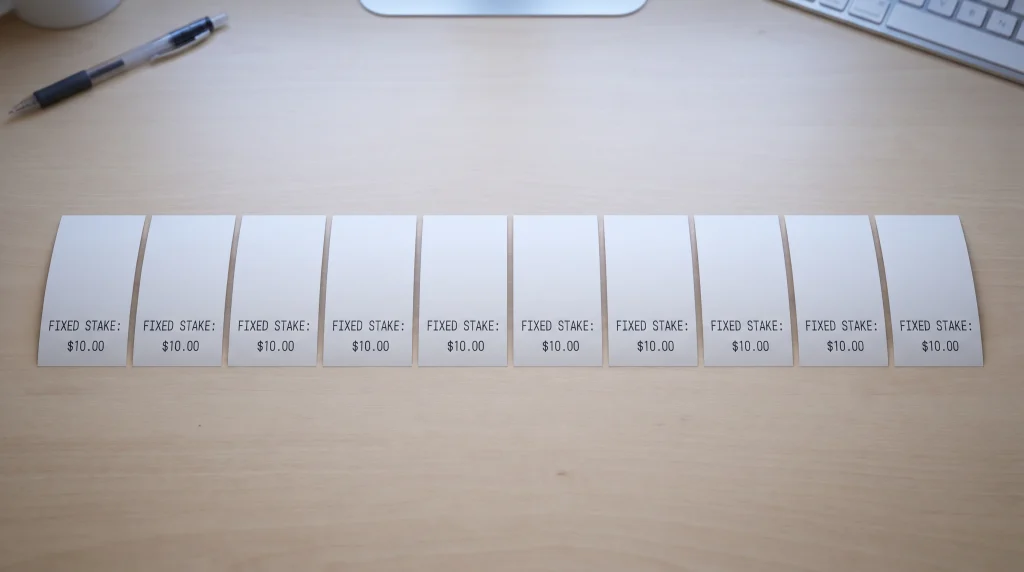
I tell every new golf bettor to start with flat staking, and I still believe it’s the right advice. One unit per bet, every bet, regardless of confidence level, odds or market type. The simplicity is its greatest strength: there are no calculations to perform, no subjective confidence assessments to corrupt, and no way to accidentally over-stake a single selection. When you’re still learning whether your analytical process generates genuine edge, flat staking isolates the question cleanly. If you’re profitable on flat stakes, your process works. If you’re not, no staking plan will save you.
The hidden cost emerges once you’ve established that your process does generate edge. Flat staking treats a 10/1 selection you’re highly confident in identically to a 40/1 speculative pick you’ve included for portfolio diversity. Both get one unit. If your confidence assessment carries predictive value — and after 300+ bets of tracking data, you can test whether it does — flat staking leaves money on the table by refusing to scale with conviction. If you add the implied probabilities of every player in a golf outright market, the total exceeds 100% by 30-50% in a 156-player field. That overround means your edge, when it exists, is concentrated in specific selections where your probability estimate diverges most from the market’s. Flat staking ignores that concentration.
The second hidden cost is that flat staking doesn’t adjust for bankroll changes. If you start a season with a £1,000 bankroll and £10 units, a 20% drawdown leaves you betting the same £10 from an £800 bankroll. Your effective exposure has increased from 1% to 1.25% per bet without any conscious decision. Over a full season with golf’s natural variance, this drift can compound into meaningful over-staking during the worst possible moment — when your bankroll is already depleted.
Despite these limitations, I still use flat staking for any market where my confidence assessment has no validated track record. New tournaments, unfamiliar courses, markets I’ve only recently added to my portfolio — all get flat stakes until I’ve accumulated enough data to justify anything more sophisticated.
Percentage Staking: Scaling with Your Bankroll
Percentage staking fixes the bankroll-drift problem by defining each bet as a fixed percentage of your current bankroll rather than a fixed monetary amount. Stake 1% per bet from a £1,000 bankroll and your first bet is £10. After a drawdown to £800, your next bet is £8. After a winning run to £1,200, your next bet is £12. The plan automatically reduces exposure during losing streaks and increases it during winning periods.

I moved to percentage staking in my second full season and the impact on drawdown management was immediate. The global sports betting market sits at $162.5 billion and is projected to reach $575 billion by 2035 — growth that will bring more recreational money into golf markets and potentially soften pricing. A staking plan that protects your bankroll through inevitable losing stretches is essential preparation for a market that’s becoming more liquid but no less volatile.
The standard percentage for golf outright betting sits between 0.5% and 2% per selection, depending on how many bets you place per tournament. If your weekly card includes 6-8 selections across different markets, 1% per bet means 6-8% of your bankroll is at risk each week. Over a season with 40+ tournaments, that cadence produces enough action to generate a meaningful sample while keeping any single week’s risk bounded. I run 1% as my base and adjust only through the Kelly-influenced modifier described in the next section.
The limitation of pure percentage staking mirrors flat staking: every bet receives the same allocation regardless of estimated edge. A selection where your model assigns a 6% probability at 25/1 odds (implied probability 4%) gets the same stake as a selection where your model assigns an 8% probability at the same 25/1. The edge is twice as large, but the stake doesn’t reflect that. For bettors comfortable with subjective confidence tiers — grouping selections into “standard” and “strong” with 1x and 1.5x multipliers — percentage staking with a manual override is a practical middle ground that I used for a full season before exploring Kelly.
Kelly Criterion in Golf: Theoretical Edge, Practical Limits
Pamela Maldonado, a sports betting analyst, described the particular psychology of golf betting in a way that resonates with anyone who’s tried to implement Kelly: “Golf betting is a slow-burn panic, like a 3-footer that suddenly feels twice as long.” Kelly criterion intensifies that dynamic because it demands something that golf makes extraordinarily difficult — an accurate estimate of your true edge on every single bet.
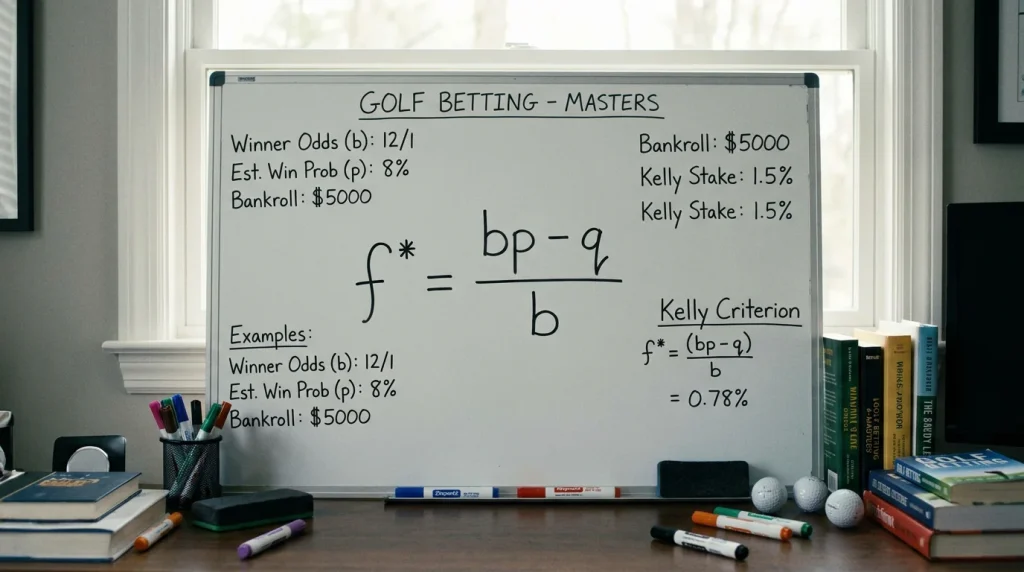
The Kelly formula is elegant: stake = (bp – q) / b, where b is the decimal odds minus 1, p is your estimated probability of winning and q is 1 minus p. If you estimate a player has a 5% chance of winning at 30/1 (decimal 31.0), Kelly says stake (30 x 0.05 – 0.95) / 30 = 1.83% of your bankroll. The formula optimises for long-term growth rate, and in theory it’s mathematically optimal — no other staking plan grows a bankroll faster without risking ruin.
In practice, full Kelly is unusable for golf. The formula assumes your probability estimates are accurate. In a sport where the best models in the world produce probability estimates with wide confidence intervals — a player you rate at 5% might genuinely be anywhere from 2% to 8% — full Kelly will routinely over-stake on selections where your estimate is too high. The consequences of over-staking under Kelly are severe: one season of inflated probability estimates can erase years of accumulated returns.
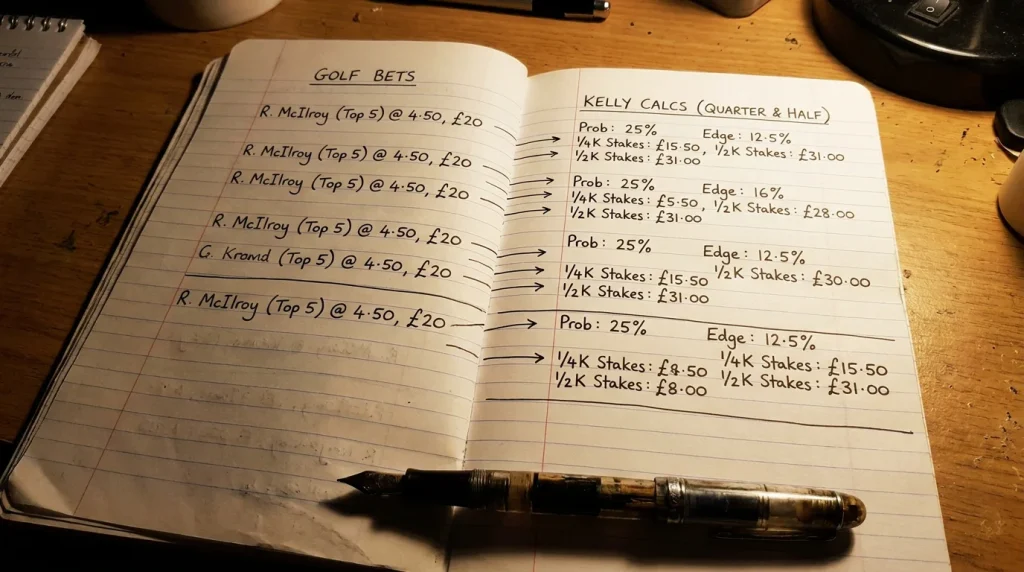
Fractional Kelly — typically quarter-Kelly or half-Kelly — is the practical solution I’ve settled on. Take the Kelly-recommended stake and multiply it by 0.25 or 0.5. This approach captures the directional benefit of Kelly (bet more when your estimated edge is larger) while dramatically reducing the damage from estimation error. My testing data across three seasons shows that quarter-Kelly outperformed flat staking and pure percentage staking on a risk-adjusted basis, though the absolute returns were slightly lower than half-Kelly with higher drawdown volatility.
The operational burden is the final practical limit. Kelly requires a probability estimate for every selection, every week. That estimate needs to be defensible, not a gut feeling with a number attached. If you’re not running a model that produces calibrated probabilities — and “calibrated” means your 5% predictions actually win about 5% of the time across a large sample — then Kelly is premature. Start with flat or percentage staking, build 300+ bets of tracking data, validate your probability estimates against observed outcomes, and only then consider whether Kelly adds value to your specific process.
Choosing a Plan That Matches Your Risk Tolerance
The right staking plan depends on three variables that only you can assess: your bankroll size relative to your income, your emotional tolerance for drawdowns, and the quality of your probability estimates. A bettor with a £500 bankroll that represents a significant portion of their discretionary income should never use Kelly — the variance is too high and the emotional cost of a drawdown too steep. Flat staking at 1% (£5 per bet) keeps the process sustainable regardless of short-term results.
A bettor with a dedicated £5,000 bankroll, two seasons of validated tracking data and probability estimates that demonstrate calibration over 500+ bets is in a position to explore fractional Kelly. The incremental return from better stake sizing only matters if the foundational process is profitable on flat stakes first. No staking plan creates edge — it only scales whatever edge already exists. If flat staking shows a negative ROI, switching to Kelly won’t fix the problem. It will accelerate it.
My recommendation, shaped by my own progression through all three plans, is a staged approach: flat staking for the first 200 bets, then percentage staking with confidence tiers for the next 200, then fractional Kelly if (and only if) your probability estimates pass a calibration test. Each stage builds the data foundation that the next stage requires. Skip a stage and you’re applying a sophisticated tool to uncertain inputs — the mathematical equivalent of using a precision instrument without calibrating it first.

Staking Plans: Common Questions
Which staking plan works best for golf outright betting?
Flat staking is the best starting point for all golf bettors because it isolates whether your selection process generates genuine edge without introducing staking-related noise. Once you have 200+ bets of validated tracking data showing positive ROI on flat stakes, percentage staking (1-2% per bet) improves bankroll management by automatically reducing exposure during losing streaks. Fractional Kelly (quarter or half) is appropriate only for bettors with calibrated probability models and substantial tracking histories.
Is the Kelly Criterion practical for golf bets with long odds?
Full Kelly is impractical for golf because it requires accurate probability estimates, and golf"s large fields and high variance make precise estimation difficult. A player you rate at 5% probability at 30/1 could genuinely be anywhere from 2% to 8%, and full Kelly would over-stake based on the optimistic end of that range. Fractional Kelly — staking 25% or 50% of the Kelly-recommended amount — captures the benefit of scaling with estimated edge while dramatically reducing the damage from estimation error.
Articles
Created by the "Golf Betting Tips" editorial team.
