
How to Bet on Golf: A Beginner's Walk-Through of Markets, Slips and First Wagers
 Available in US
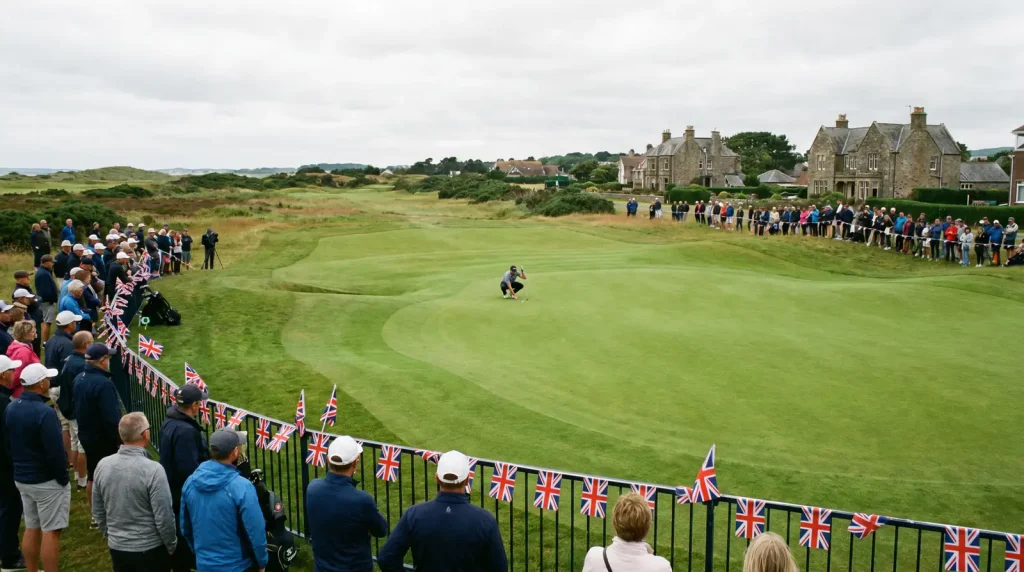
My first golf bet was a disaster. I walked into a betting shop in 2018, asked for “five quid on Rory McIlroy to win the Open,” and was handed a slip that said “outright winner” in small print. I had no idea what “outright” meant, what the alternative was, or why the man behind the counter asked if I wanted it “each way.” I said no because I did not want to look stupid. McIlroy finished tied for fifth. If I had said yes, I would have been paid out.
Golf rounds in the UK hit a record in 2025 — up 14% on the previous year, the highest level since comparable records began in 2005. More people are playing, more people are watching, and more people are curious about putting a few pounds on the action. But the gap between “curious” and “confident” is surprisingly wide when it comes to golf betting. The markets are different from football or horse racing, the terminology is unfamiliar, and the sheer size of the field makes the whole thing feel more complicated than it needs to be.
This guide is for anyone standing where I stood in 2018: interested, willing to learn, and starting from scratch. No assumptions about what you already know. Every term explained. Every step walked through. By the end, you will understand the markets, the mechanics of a bet slip, and the four things worth checking before you commit a single pound.
How a Golf Tournament Works and Why It Matters for Betting
Before you place a bet on golf, it helps to understand what you are actually betting on. A professional golf tournament is not a single event — it is a four-day competition spread across Thursday to Sunday, and the structure of those four days affects every market on the board.
In a standard stroke-play tournament, between 120 and 156 players begin on Thursday. Each plays 18 holes per day. After the second round on Friday, a “cut” eliminates roughly half the field — usually the players whose two-round total is above a certain score. Only those who make the cut play the weekend rounds (Saturday and Sunday), and the player with the lowest total score after 72 holes wins.
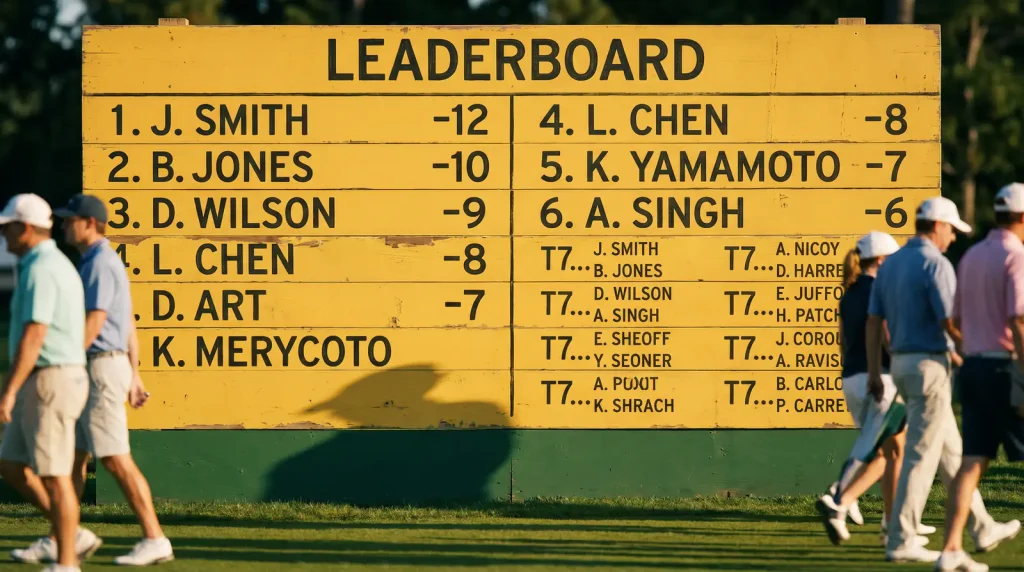
That cut is important for betting. If you back a player to win the tournament outright and he misses the cut on Friday, your bet is dead with two full days of golf still to play. The cut also creates specific betting markets of its own — you can wager on whether a player will make or miss the cut, and those markets are particularly useful for punters who want action without needing a player to finish in the top five.
England Golf reported 11.83 million scores submitted through the World Handicap System in 2025 — a 16% increase and an all-time record since the system launched. That surge in grassroots participation feeds directly into betting interest, because more golfers understand the nuances of scoring, course difficulty, and form. If you play the game yourself, even casually, you already have more context than you realise for evaluating betting markets.
Not every tournament follows the standard format. Some events — particularly team competitions like the Ryder Cup or newer formats like the TGL simulator league — use match play, foursomes, or modified scoring systems. The betting markets for these events are structured differently, and the odds reflect the altered format. For the purposes of this guide, I am focusing on standard 72-hole stroke play, which accounts for the vast majority of professional golf betting volume.
Every Golf Betting Market Explained in Plain Terms
Golf offers more betting markets than most people expect. Walk into any UK sportsbook — online or on the high street — during a PGA Tour week and you will find a menu that stretches well beyond “who will win.” Here is what each market means in plain terms, starting with the most popular and working outward. For the more exotic options — hole-in-one bets, top nationality, and novelty wagers — I have put together a separate guide on golf prop bets and how they work.
Outright, Top 5, Top 10, Top 20
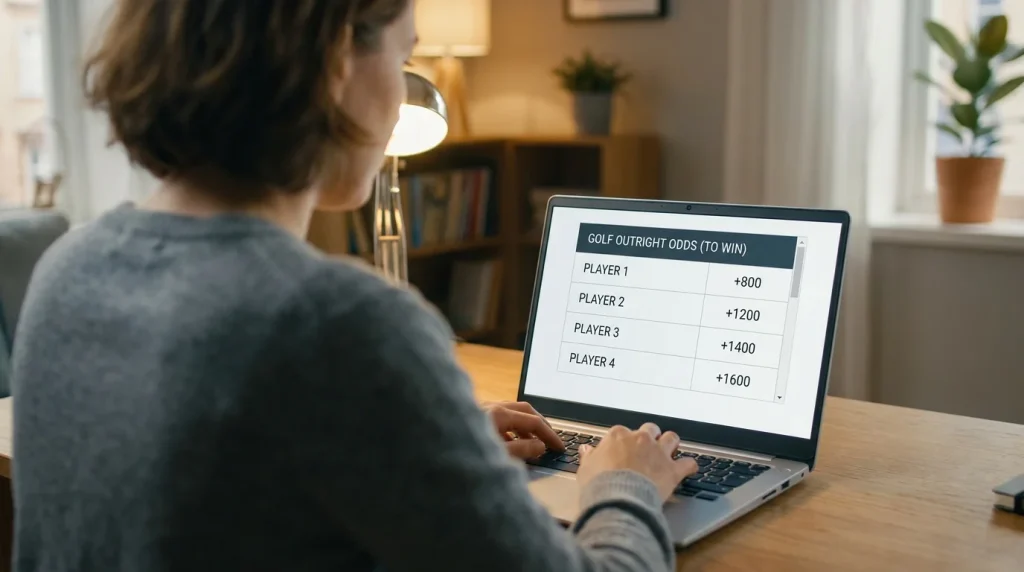
The outright winner market is the headline bet: pick the golfer who will finish first after 72 holes. Because fields are large — typically 144 to 156 players — the odds are long. Even the world number one might be priced at 8/1 or 10/1 for a given tournament, and mid-ranked players can sit at 50/1, 80/1, or longer. That length of odds is what makes golf outrights exciting and also what makes them hard to win consistently.
Top-finish markets narrow the target. Instead of picking the winner, you are picking a player to finish in the top 5, top 10, or top 20. The odds are shorter because the probability is higher — a solid professional might have a 25% chance of a top-20 finish but only a 2% chance of winning outright. These markets are excellent for beginners because they offer a higher hit rate and a gentler introduction to the mechanics of golf betting. You still need to pick well, but you do not need to pick the single best player in a field of 156.
The relationship between outrights and top-finish markets is worth understanding early. The outright price implicitly contains a top-finish probability. A player at 20/1 to win is not just a win proposition — those odds also imply a certain likelihood of placing highly. Some punters find better value in the top-finish market for the same player, depending on how each market is priced. Comparing the two before committing your stake is a habit worth building from the start.
Each-Way Primer for New Punters
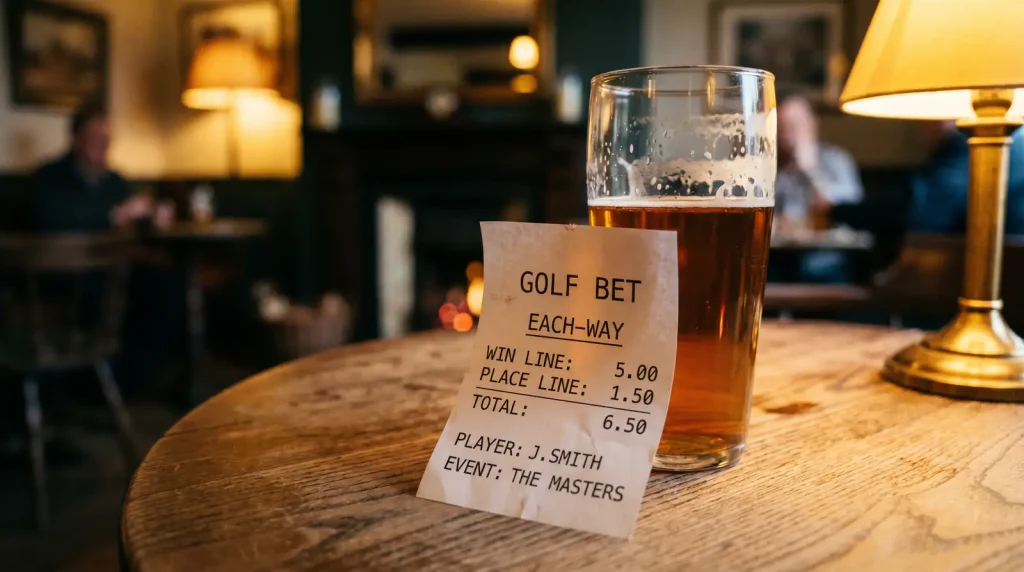
Each-way betting is the most popular format for golf bets in the UK, and for good reason. When you place an each-way bet, you are making two bets in one: a bet on your player to win and a separate bet on him to finish inside a set number of places (usually the top five or six). If he wins, both halves pay. If he finishes in the top five but does not win, the place half still pays out — at a fraction of the win odds, typically one-quarter or one-fifth.
The practical effect is that each-way gives you a safety net. Your player does not have to win the tournament for you to see a return. He just needs to finish well. The cost is that each-way doubles your stake — a GBP5 each-way bet is actually a GBP10 total outlay, GBP5 on the win and GBP5 on the place. That doubled cost is the most common source of confusion for new punters, so be clear about it before you place the slip.
Each-way works best with players priced at 20/1 and above. Below that, the place-half payout is often too small to justify the doubled stake. I use each-way as my default for golf outright bets and switch to straight win only when the odds are short and I have strong conviction in a player’s win probability.
Match Bets, 3-Balls and Props
Match bets pit two golfers directly against each other: whoever finishes with the lower total score wins the bet, regardless of where either player finishes in the overall tournament. These are closer to a coin-flip proposition than an outright, which makes them appealing for punters who prefer higher-probability wagers. The odds reflect the closeness of the matchup — two evenly matched players might both be priced around 10/11, while a clear favourite over a weaker opponent might be 4/7.
A 3-ball bet is similar but involves three players, typically those who are grouped together for a particular round. You pick which of the three will post the lowest score for that day. Because there are three possible outcomes rather than two, the odds are slightly longer, but dead heats can occur when two of the three players finish on the same score — a situation that reduces your payout under the dead heat rule.
Prop bets — short for proposition bets — cover everything outside the standard markets. Will there be a hole-in-one during the tournament? Which nationality will the winner represent? Will the winning score be over or under a certain number? These markets are entertaining and occasionally offer genuine value, but they require a different analytical approach from the core markets. For a beginner, outrights, top-finish, each-way, and matchups are more than enough to get started.
Placing Your First Golf Bet: A Step-by-Step Walk-Through
The mechanics of placing a golf bet are straightforward, but the first time feels more complicated than it is. Here is the walk-through, step by step, for an online sportsbook — which is where the vast majority of UK golf bets are placed. Around 95% of online gambling in the UK happens from home, and 76% of bettors aged 18-24 use mobile phones, so chances are you will be doing this on your sofa with a phone in hand.
Step one: open the sportsbook app or website and navigate to golf. Most operators list golf under “sports A-Z” or as a featured sport during tournament weeks. You will see the current week’s tournament at the top, with outright winner as the default market.
Step two: browse the players and odds. The list is typically sorted by price, with the favourite at the top. Tap or click on a player’s odds to add the selection to your bet slip. The slip will appear at the bottom of the screen (mobile) or in a sidebar (desktop).
Step three: choose your bet type. On the bet slip, you will see options for “win” (straight outright) and “each way.” If you select each-way, the slip will show the place terms — something like “1/5 odds, 5 places.” It will also show that your total stake is doubled. Enter your stake per bet, not the total. A GBP5 stake each-way means GBP10 total.
Step four: confirm the bet. Review the slip one final time. Check the player, the odds, the bet type, the stake, and the total outlay. Then submit. You will receive a confirmation with a bet reference number. Save it or screenshot it — you will need it if there is ever a query.
Step five: wait. Golf bets do not settle until the tournament ends, which is typically Sunday evening. Some markets — first round leader, round matchups, make/miss cut — settle earlier. But an outright or each-way bet runs for the full four days. Get comfortable with that timeline. It is slower than football and faster than a futures bet, and the rhythm suits a patient approach.

One practical note: most UK sportsbooks require you to create an account and verify your identity before placing a bet. This involves providing proof of age and address, which takes a few minutes online but can take longer if manual checks are needed. Do this before tournament week so you are ready to bet when the markets are most active — typically Tuesday through Wednesday evening.
Four Factors to Check Before Every Golf Bet
When I was starting out, I backed players based on name recognition. Tiger Woods, Phil Mickelson, whoever I had watched on television the previous Sunday. It took me a full season to realise that name recognition and betting value are almost never the same thing. The PGA Tour saw golf betting handle grow 20% in 2025, and that growth is driven overwhelmingly by punters who check factors beyond the name on the jersey. Here are four worth checking every time.
First, recent form. Has the player made the cut in his last three or four starts? What has his scoring average looked like over the past month? A player who has missed three consecutive cuts is not automatically a bad bet — he might be returning to a course where he has a strong record — but the burden of evidence is on you to justify why this week will be different. Start with form, then look for reasons to override it.
Second, course fit. Golf courses vary enormously. Some reward long hitters. Some reward accuracy off the tee. Some demand exceptional putting on fast, sloped greens. A player’s statistical profile — driving distance, greens in regulation, scrambling, putting average — tells you whether his strengths match what the course demands. This is the single most overlooked factor among new golf bettors, and it is where the biggest edges often hide.
Third, field strength. Not all tournaments attract the same quality of player. A signature event on the PGA Tour might feature the world’s top 70 players, while a regular-season event might have a much thinner field with only a handful of top-50 names. The strength of the field affects the odds and the difficulty of finishing well. A mid-ranked player has a realistic chance of a top-10 finish in a weak field but almost none in a stacked one.
Fourth, conditions. Weather forecasts, particularly wind speed and direction, can reshape a golf tournament. Tee-time draws also matter — players who go out early on Thursday might face calm conditions while the afternoon wave battles 25 mph gusts. Checking the weather and the draw takes five minutes and can completely change your assessment of a player’s chances for the week.
You do not need to build a spreadsheet model to use these four factors. You just need to check all four before placing the bet, every time, without exception. The discipline of that check — rather than the sophistication of the analysis — is what separates punters who learn from punters who keep repeating the same mistakes.
Five Mistakes New Golf Bettors Make
Scott Warfield, the PGA Tour’s Vice President of Gaming, has talked about wanting to “grow the pie and get more people engaged around the sport.” That engagement is real — and growing — but new bettors often stumble into the same traps. Here are five mistakes I see repeatedly, all of which I made myself in my first year.
Mistake one: betting every tournament. The PGA Tour and DP World Tour together run events in 48 weeks of the year. You do not need to bet on all of them. Some weeks the value is thin, the field is unfamiliar, or the course does not lend itself to confident analysis. Sitting out a week costs nothing. Betting a week you have not properly assessed costs real money.
Mistake two: backing only the big names. The favourite in a golf tournament wins roughly 8% to 12% of the time. That means 88% to 92% of the time, someone else lifts the trophy. Focusing exclusively on well-known players means you are fishing in the same small pool as everyone else, which compresses the odds and reduces the value. Some of the best bets in golf come from the middle of the field — players ranked 40th to 80th in the world who are overlooked by casual punters.
Mistake three: ignoring the each-way option. New punters often default to straight win bets because they do not understand how each-way works. This is the most costly beginner error in golf betting, because each-way dramatically improves your chances of a return. Learn the mechanics, understand the place terms, and use each-way as your default for outright markets at 20/1 and above.
Mistake four: chasing losses. A losing streak in golf betting is not a bug — it is a feature. The nature of the sport means you will lose the majority of outright bets. If a run of five or six losers sends you into a spiral of increased stakes or desperate picks, you will burn through your bankroll before the variance has a chance to even out. Set a weekly budget, stick to it, and treat each tournament as an independent event.
Mistake five: not recording your bets. If you do not track what you bet, at what odds, and what happened, you have no data to improve from. A simple notebook or spreadsheet with the date, player, market, odds, stake, and result is enough. After 50 bets, patterns will emerge — certain markets where you consistently find value, certain types of player you overrate or underrate — and those patterns are the foundation for getting better.

How to Bet on Golf: Frequently Asked Questions
What is the minimum stake for a golf bet with UK bookmakers?
Most UK online bookmakers accept minimum stakes of GBP0.10 to GBP1.00 per bet. High-street betting shops may set a slightly higher minimum, typically GBP0.50 or GBP1.00. These low thresholds make it easy for beginners to experiment with small amounts while learning the markets.
Can I bet on golf using a mobile app?
Yes. Every major UK-licensed bookmaker offers a mobile app for iOS and Android with full access to golf betting markets, including outrights, each-way, matchups, and in-play options. The majority of UK golf bets are now placed via mobile devices.
How soon before a tournament do golf betting markets open?
Outright winner markets typically open on Monday or Tuesday of tournament week, once the field is confirmed. Futures markets for major championships may open months in advance. Matchup and round-by-round markets usually appear on Wednesday once pairings and tee times are published.
What happens to my bet if a golfer withdraws?
If your selected golfer withdraws before the tournament begins, most UK bookmakers void the bet and return your stake. If the player withdraws during the tournament — after completing at least one hole — the bet typically stands and is settled as a loser. Always check the individual bookmaker"s withdrawal rules, as terms can vary.
Your First Golf Bet Should Be a Small One
Golf betting rewards patience. The tournaments are long, the fields are large, and the learning curve is steeper than most sports. But that complexity is also the opportunity — the punters who invest in understanding the markets, checking the four key factors, and tracking their bets from the start will find themselves with a genuine advantage over the majority who never get past “back the big name to win.”
Start small. Start with one bet per tournament. Start with each-way on a player you have actually researched. And start a log. Everything else builds from there.
Articles
Published by the Golf Betting Tips team.
