
TGL Betting Guide: How the Indoor Simulator League Creates New Golf Markets
 Available in US

The first TGL match I watched felt like someone had taken golf and put it through a blender with arena sports. Players in team kits, a massive indoor facility, a screen the size of a cinema showing virtual holes overlaid on real putting surfaces, and a crowd that cheered like they were at a basketball game rather than a golf event. My initial thought was: this is entertainment, not betting material. My second thought, about forty minutes later, was: this is a market with almost no analytical coverage and bookmakers who are pricing from thin air. That second thought is the one that matters.
The global sports betting market sits at $162.5 billion in 2025 and is projected to reach $575 billion by 2035. New formats like TGL represent the frontier where that growth is happening — and where the pricing is least mature.
TGL Format: Teams, Simulator Sessions and Scoring
TGL — Tomorrow’s Golf League — operates on a team-based format played inside the SoFi Center, a purpose-built arena that combines a massive virtual-reality screen for approach shots and tee shots with a real, physical short-game area for chipping and putting. PGA Tour LIVE Betcast expanded from 50 hours across 6 tournaments to over 400 hours across 12 in 2026, a 700% increase that signals the Tour’s appetite for technology-driven coverage. TGL pushes that further by making technology the playing field itself.

Each TGL team consists of PGA Tour players drafted onto franchise rosters. Matches are played between two teams over 15 holes — 9 in a “triples” format (three players per side, similar to a modified best-ball) and 6 in “singles” (one-on-one match play). The first 9 holes use the simulator for full shots, with players hitting real balls into the screen and the technology tracking ball flight and landing position. Each hole finishes on the real short-game area, where players chip and putt on a physical green.
The scoring is match play at its core: each hole is won, lost or halved, and the team with the most holes won at the end of the 15 takes the match. Unlike stroke play, where a single blow-up hole can be mitigated over 72 holes, match play means every hole carries equal weight. A triple bogey on a par 3 costs you one hole — the same as losing with a birdie to your opponent’s eagle. That compression of outcomes changes the probability distribution in ways that traditional golf betting models don’t capture.
For bettors, the compressed format means less time for regression to the mean. In a 72-hole PGA Tour event, the best player in the field has four rounds to assert their talent. In a 15-hole TGL match, the variance per decision point is much higher. Hot putting over 15 holes can swing a match; over 72 holes, it tends to wash out. Understanding that variance is the first step to pricing TGL markets accurately.

TGL Betting Markets Available to UK Punters
The PGA Tour recorded a 20% increase in golf betting handle in 2025, and TGL represents a new channel through which that growth is being directed. UK bookmaker coverage of TGL is growing but remains limited compared to PGA Tour stroke-play events. Not all operators list TGL markets, and those that do tend to offer a narrower range.
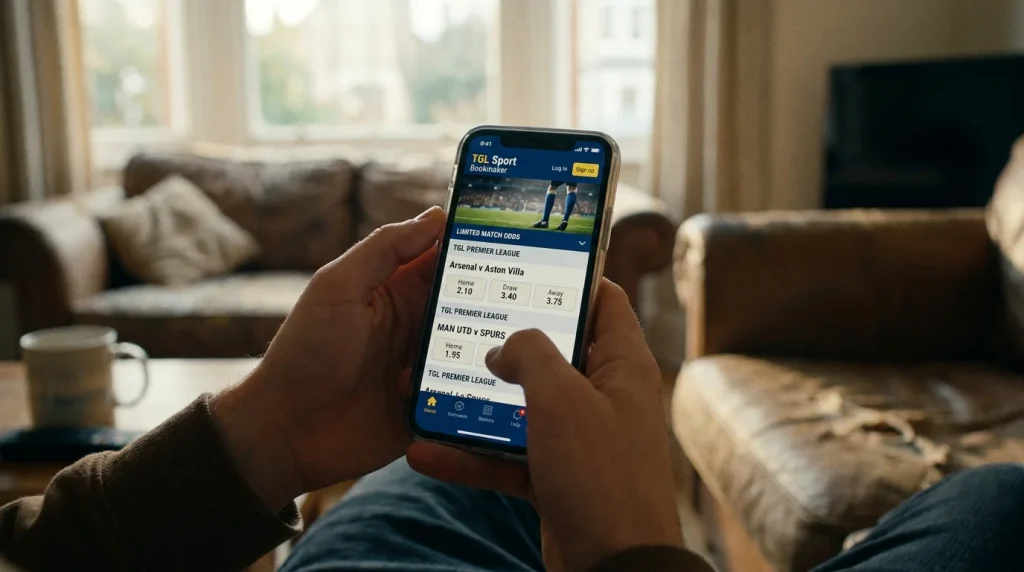
Match winner — which team wins the overall 15-hole contest — is the primary market and the one with the most liquidity. Pricing follows match-play dynamics: the favourite is rarely shorter than 4/6 because the format’s inherent variance prevents any team from dominating predictably. Head-to-head singles matchups within the overall team contest appear at some bookmakers, offering the most granular betting option — one player against one player over 6 holes of individual match play.
Total holes won and match margin (e.g., “Team A to win by 3+ holes”) are the over/under equivalents in TGL betting. These require a feel for how the format distributes hole outcomes. In early TGL seasons, matches have tended to be close — the talent level across teams is deliberately balanced through the draft process — which means the over on total holes won and the favourite at a large margin are both structurally risky bets.
Season-long markets — which team wins the TGL championship — attract futures-style betting. With only six teams and a short season, the championship market is a small-field proposition where draft quality and roster health are the primary variables. Injuries to a single key player can swing a team’s championship odds more dramatically than in any other golf format because rosters are small and replacement depth is limited.
Data Challenges: Short History and Cross-Referencing PGA Stats
Scott Warfield, the PGA Tour’s Vice President of Gaming, described the broader growth ambition in terms that apply directly to TGL: “We’re trying to grow the pie and get more people engaged around the sport.” TGL is one of the most visible instruments of that growth. But for bettors, the analytical gap between ambition and available data is wide enough to drive a bus through.

The fundamental problem is sample size. TGL launched recently, and each team plays a limited number of matches per season. That means any performance trends you observe — “this team dominates the triples format” or “this player is unbeatable in singles” — are built on tiny samples that may reflect randomness rather than genuine patterns. I’ve seen bettors construct elaborate TGL models from a single season of data. That’s model-building on sand.
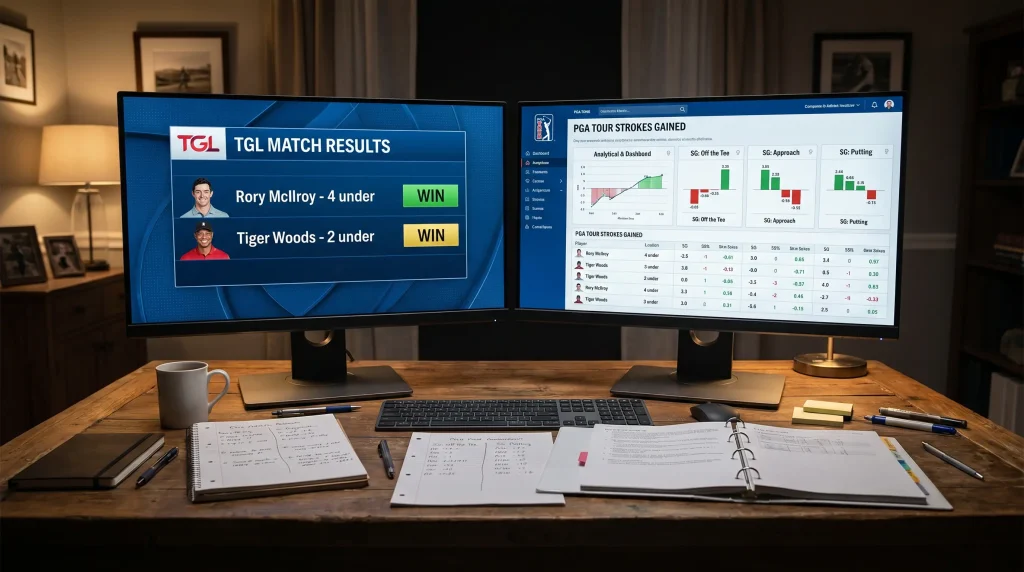
Cross-referencing PGA Tour statistics is the workaround, but it’s imperfect. A player’s strokes gained profile from 72-hole stroke play tells you about their skill level in absolute terms, but it doesn’t tell you how they’ll perform in a 15-hole match-play format played partly on a simulator and partly on a real green. The skills transfer is partial: putting and short-game touch translate directly because the physical surface is real. Full-swing performance on the simulator introduces variables — screen perception, launch monitor calibration, the psychological difference between hitting into a screen versus hitting into open space — that have no equivalent in traditional golf data.
My approach to TGL betting is deliberately conservative. I use PGA Tour strokes gained data to rank the relative skill levels of players on each roster, then adjust for the limited TGL-specific data that exists. Staking is reduced to half my normal unit size, reflecting the lower confidence in any prediction. And I focus on the singles market rather than the overall match, because one-on-one matchups are the format where PGA Tour skill data translates most directly — the triples format introduces team dynamics that individual statistics can’t predict.
The analytical edge in TGL, at this stage of the league’s development, doesn’t come from superior modelling. It comes from disciplined humility about what you don’t know, combined with a willingness to bet small when the pricing reflects the market’s own confusion. Bookmakers are learning how to price TGL in real time, and some of that learning is visible in wild price swings between the opening market and match start. If you can identify when a price is structurally wrong — a team heavily favoured despite a key player sitting out, or a matchup priced as even despite a clear skill gap — the edge is there. But it’s manual, situational and requires watching the matches live rather than relying on pre-match analysis alone.
TGL Betting: Common Questions
Can I bet on TGL matches with UK bookmakers?
Yes, though coverage varies by operator and by match. The most commonly available market is match winner (which team wins the overall 15-hole contest). Some bookmakers also offer head-to-head singles matchups, total holes won, match margin and season-long championship futures. Check multiple operators for availability, as TGL markets are not universally listed and pricing can differ significantly between bookmakers due to the limited market liquidity.
How do I analyse TGL players when there is no course history?
Cross-reference PGA Tour strokes gained data to assess each player"s overall skill level, with particular attention to short-game and putting metrics that translate directly to TGL"s real-surface putting greens. Accept that full-swing simulator performance introduces variables not captured by traditional statistics. Reduce staking to reflect lower analytical confidence, focus on singles matchups where individual skill is the primary variable, and treat any TGL-specific patterns from prior seasons as preliminary signals rather than reliable trends given the small sample sizes.
Articles
Published by the Golf Betting Tips team.
